
There is a reason serious birdwatchers speak of Uganda in the same reverent tones they reserve for the Amazon Basin, the Himalayas, and the great birding frontiers of Papua New Guinea. This small, landlocked East African nation — just 241,038 square kilometres, smaller than the United Kingdom — packs a density of avian life that is almost impossible to comprehend until you are standing inside it, binoculars raised, in a forest that seems to produce a new and extraordinary species with every turn of the trail.
Uganda has recorded over 1,080 bird species — more than the entire North American continent, more than all of Europe combined, and representing approximately 11% of the world's total bird species within a country that occupies less than 0.2% of the earth's land surface. This extraordinary concentration of birdlife is the product of Uganda's remarkable ecological position at the intersection of East Africa's savannah ecosystems, West Africa's equatorial rainforest zone, and the unique montane habitats of the Albertine Rift — one of the most important bird endemism zones on the planet.
The Albertine Rift alone — the western arm of the Great Rift Valley, running along Uganda's western border — harbours 39 endemic bird species found nowhere else on earth. Uganda holds more Albertine Rift endemics than any other country in the region, and encountering them — in the montane forests of Bwindi, the papyrus swamps of the Albertine lakes, and the ancient forests of the Rwenzori Mountains — is the defining experience of East African birding.
This 16-day Uganda birding safari has been designed by Ntungo Wildlife Safaris to move systematically through Uganda's most productive and diverse birding habitats, from the papyrus swamps of Mabamba on Lake Victoria — home to the iconic shoebill stork — through the forests of Kibale, the savannahs and wetlands of Queen Elizabeth National Park, the ancient rainforest of Bwindi Impenetrable Forest, the montane slopes of the Rwenzoris, and the spectacular waterfall environment of Murchison Falls. Combined with outstanding mammal wildlife throughout — including chimpanzee tracking, gorilla trekking, and big game viewing — this itinerary delivers the full breadth of Uganda's extraordinary natural heritage for the dedicated birder.
Pack your binoculars, charge your camera, and prepare for one of the finest avian journeys on earth.
Day 1: Arrival in Entebbe — Gateway to the Pearl of Africa
Your 16-day Uganda birding safari begins at Entebbe International Airport, situated on a lush, forested peninsula extending into the vast expanse of Lake Victoria — Africa's largest lake and, appropriately for a birding safari, a habitat of considerable ornithological interest in its own right.
Your Ntungo Wildlife Safaris representative will meet you in the arrivals hall and transfer you to your accommodation in Entebbe. The town itself — unhurried, green, and set beside the lake — provides an excellent first introduction to Ugandan birdlife. The grounds of the Uganda Wildlife Education Centre adjacent to the Entebbe Botanical Gardens (established 1898) are home to a remarkable variety of species even before the formal safari begins: African fish eagles, grey crowned cranes, pied kingfishers, African jacanas, long-tailed cormorants, and various sunbird species are commonly observed from the hotel grounds and surrounding lakeside vegetation.
This evening, after dinner, your guide will brief you on the itinerary ahead — discussing species targets for each habitat zone, bird behaviour, equipment recommendations, and the logistics of the days to come. An early night is strongly advised: Uganda's birding begins at dawn, and dawn comes early in the equatorial tropics.
Key Species: Grey crowned crane, African fish eagle, pied kingfisher, African jacana, long-tailed cormorant, various sunbirds Meal Plan: Dinner Accommodation: Protea Hotel by Marriott Entebbe / Boma Guest House
Day 2: Mabamba Swamp — The Shoebill and the Papyrus World
The alarm sounds before dawn today, and with good reason: Mabamba Swamp on the northern shore of Lake Victoria is the most reliable site in Uganda — and one of the most reliable in the world — for close encounters with the shoebill stork (Balaeniceps rex), one of Africa's most prehistoric, most sought-after, and most extraordinary birds.
The shoebill is a bird of almost surreal appearance: standing up to 145 centimetres tall, with a massive, hook-tipped bill resembling a Dutch clog that gives it its name, slate-grey plumage, and large, unblinking yellow eyes that regard the world with what can only be described as ancient indifference. It is a solitary, slow-moving specialist of papyrus swamp and shallow marsh environments, hunting lungfish, catfish, and other aquatic prey with a patience and stillness that makes it almost invisible until it moves. To find a shoebill in the papyrus, approach it slowly by canoe, and watch it hunt from close range is one of the defining experiences of African birding — a genuinely prehistoric encounter with a species that seems to have arrived from another geological era.
Mabamba Swamp is a wetland of international significance covering approximately 2,400 hectares of papyrus swamp, open water, and floating vegetation mats on Lake Victoria's Entebbe peninsula shoreline. The swamp is explored by traditional wooden canoe, guided by local community members trained specifically in shoebill location and wildlife interpretation — a model that combines exceptional birding with direct community benefit.
Beyond the shoebill, Mabamba's papyrus zone supports a remarkable community of wetland birds. The papyrus yellow warbler — a species of global conservation concern restricted entirely to papyrus swamp habitats — is regularly encountered here, as are the white-winged warbler, papyrus gonolek, lesser swamp warbler, African pygmy goose, malachite kingfisher, pygmy kingfisher, African water rail, purple swamphen, and numerous heron species. African marsh harriers quarter low over the papyrus, and long-toed lapwings pick their way across the floating vegetation with extraordinary delicacy.
After a morning of exceptional wetland birding, return to Entebbe for lunch before an afternoon transfer to your accommodation near Kampala or onward toward the western birding circuit.
Key Species: Shoebill stork, papyrus yellow warbler, white-winged warbler, papyrus gonolek, African pygmy goose, malachite kingfisher, African marsh harrier Meal Plan: Breakfast, Lunch, Dinner Accommodation: Entebbe / Kampala area
Day 3: Transfer to Kibale National Park via Mpanga Forest
Today begins the overland journey westward to Kibale National Park — Uganda's primate capital and one of the finest forest birding destinations in East Africa. The drive from Entebbe takes approximately 5–6 hours through increasingly beautiful landscape, and the route is not without birding opportunities of its own.
A planned stop at Mpanga Forest Reserve near Kampala provides an excellent introduction to Uganda's forest birding. Mpanga is a small but extraordinarily productive patch of medium-altitude forest managed as a research and recreation reserve, with well-maintained trails that allow systematic coverage of its interior. The forest holds an impressive list of species for its size, including the African emerald cuckoo, black-and-white casqued hornbill, yellow-spotted barbet, grey-throated barbet, African broadbill, blue-headed bee-eater, Narina trogon, little green sunbird, Stuhlmann's starling, and numerous species of greenbul, illadopsis, and robin-chat.
Roadside birding en route to Kibale is also productive — open country species including long-crested eagles, augur buzzards, African harrier-hawks, wattled lapwings, cattle egrets, yellow wagtails, and the ever-charming superb starling are commonly observed from the vehicle.
Arrive at your Kibale lodge in the late afternoon, with time for a brief garden birding session before dinner. The lodge grounds at Kibale are themselves excellent for forest edge species — yellow-rumped tinkerbirds, African blue flycatchers, and various weavers are regular visitors.
Key Species: African emerald cuckoo, black-and-white casqued hornbill, Narina trogon, blue-headed bee-eater, African broadbill, long-crested eagle Meal Plan: Breakfast, Lunch, Dinner Accommodation: Kibale area lodge (Ndali Lodge / Turaco Treetops / Chimpanzee Forest Guesthouse)


Day 4: Kibale National Park — Forest Birding & Chimpanzee Tracking
Kibale National Park is Uganda's premier primate destination — home to over 1,500 chimpanzees and 12 other primate species — but for dedicated birders, it is equally important as one of the finest forest birding habitats in East Africa. The park protects 795 square kilometres of tropical moist forest, transitional woodland, and wetland at altitudes between 1,100 and 1,590 metres, and its 375+ recorded bird species include an exceptional concentration of forest specialists, Albertine Rift endemics, and sought-after rarities.
The day begins with an early morning forest walk — the most productive time for forest birding when species are most active and vocal. The interior trails of Kibale are among the finest forest birding walks in Uganda. Listen and look for the green-breasted pitta — one of Uganda's most electrifyingly beautiful and most sought-after species, a jewel of the forest floor that is more often heard than seen. The African pitta is equally sought-after and present in the forest during the wet season. The yellow-billed barbet, hairy-breasted barbet, black-and-white casqued hornbill, white-headed woodhoopoe, and Cassin's spinetail are among the canopy highlights.
The Albertine Rift endemics represented in Kibale include the Rwenzori apalis, collared apalis, Rwenzori batis, Rwenzori turaco — one of the most spectacular birds in Uganda, a vivid green turaco with crimson wing patches that is heard constantly and seen regularly in the forest canopy — and the stripe-breasted tit. The blue-headed sunbird and regal sunbird are both present and often observed feeding on flowering trees along the forest trails.
In the mid-morning, the birding walk transitions naturally into chimpanzee tracking — one of Uganda's great wildlife experiences, combining primate observation with continuing forest birding as the group moves through the forest in search of one of Kibale's habituated chimpanzee communities.
The afternoon offers the Bigodi Wetland Sanctuary Walk — a community-managed guided trail through the papyrus and forest swamp adjacent to the national park. Bigodi is one of Uganda's most productive birding sites for a combination of wetland, forest edge, and garden species: the papyrus gonolek, white-winged warbler, Stuhlmann's double-collared sunbird, grey-winged robin-chat, and numerous species of weaver, cisticola, and warbler are all regularly recorded.
Key Species: Green-breasted pitta, Rwenzori turaco, blue-headed sunbird, regal sunbird, Rwenzori apalis, collared apalis, African pitta, black-and-white casqued hornbill Meal Plan: Breakfast, Lunch, Dinner Accommodation: As Day 3
Day 5: Kibale to Queen Elizabeth National Park — Crater Lakes & the Rift Valley
After a final early morning birding walk in Kibale's forest, today's drive takes you south to Queen Elizabeth National Park — Uganda's most visited protected area and, for birders, one of the most extraordinary in Africa, with over 600 recorded species across its diverse mosaic of savannah, wetland, forest, and Rift Valley lake habitats.
The route south passes through the spectacular crater lake district near Fort Portal — a landscape of ancient volcanic calderas filled with shimmering water and surrounded by community farmland, papyrus, and remnant forest. Roadside birding along this route is excellent, with African hoopoes, red-chested sunbirds, purple-breasted sunbirds, variable sunbirds, common waxbills, bronze mannikins, yellow-backed weavers, and the stunning Holub's golden weaver all possible from the vehicle or at brief stops.
Arriving in Queen Elizabeth National Park in the early afternoon, a game drive through the Kasenyi Plains introduces the open-country avifauna: the majestic kori bustard stalking the grassland, the extraordinary secretary bird hunting with its long-legged kicks, Denham's bustard, crowned lapwing, black-headed lapwing, wattled lapwing, African wattled lapwing, Abyssinian roller, lilac-breasted roller, rufous-naped lark, and the unmistakeable grey crowned crane — Uganda's national bird — in pairs and family groups across the open grassland.
Key Species: Kori bustard, secretary bird, Denham's bustard, grey crowned crane, Abyssinian roller, lilac-breasted roller, numerous lapwing and lark species Meal Plan: Breakfast, Lunch, Dinner Accommodation: Mweya Safari Lodge / Marafiki Lodge / Bush Lodge
Day 6: Queen Elizabeth National Park — Kazinga Channel & Savannah Birding
A full day dedicated to exploring Queen Elizabeth National Park's extraordinary avian diversity across its two most productive birding environments: the open savannah plains and the world-famous Kazinga Channel.
The morning game drive through the Kasenyi and Mweya peninsulas continues the savannah birding of the previous afternoon. The open grassland and acacia woodland of QENP supports an exceptional diversity of raptors — martial eagle, long-crested eagle, bateleur, Wahlberg's eagle, African hawk-eagle, white-backed vulture, Rüppell's vulture, hooded vulture, and lappet-faced vulture are all recorded here, and the park's thermal columns on warm mornings can produce spectacular multi-species raptor gatherings. The woodland margins are productive for black-billed barbet, double-toothed barbet, grey-capped warbler, African grey flycatcher, and the beautiful African paradise flycatcher in both its rufous and white morphs.
The centerpiece of the day is the Kazinga Channel boat cruise — a two-hour journey along the 32-kilometre channel connecting Lake George and Lake Edward, and one of the finest waterbird birding experiences in East Africa. The channel's banks are alive with birdlife: African fish eagles call from overhanging trees, pied kingfishers hover above the surface, malachite kingfishers perch brilliantly on reed stems at close range, giant kingfishers hunt from exposed branches, and the rare shining-blue kingfisher — one of Uganda's most sought-after waterway species — inhabits the densely vegetated bank sections.
Wading birds along the channel include goliath heron — the world's largest heron, standing nearly 150 cm tall — black-headed heron, grey heron, purple heron, squacco heron, African spoonbill, yellow-billed stork, African openbill stork, and pink-backed pelican. The water surface hosts African pygmy goose, knob-billed duck, spur-winged goose, and African jacana walking impossibly across lily pads on their extraordinary elongated toes.
Key Species: Shining-blue kingfisher, goliath heron, African fish eagle, pink-backed pelican, pied kingfisher, martial eagle, bateleur, African paradise flycatcher, African pygmy goose Meal Plan: Breakfast, Lunch, Dinner Accommodation: As Day 5
Day 7: Queen Elizabeth — Maramagambo Forest & Ishasha Sector
Today explores two of Queen Elizabeth National Park's most distinct and productive birding environments: the Maramagambo Forest in the park's central region, and the famous Ishasha sector in the remote south.
Maramagambo Forest is a significant patch of medium-altitude forest within the national park that provides a critical habitat corridor and harbours a forest bird community quite distinct from the surrounding savannah. The forest is accessed via guided walk and holds species including the African crowned eagle — Africa's most powerful eagle, capable of taking prey significantly larger than itself — black-and-white casqued hornbill, chocolate-backed kingfisher, blue-throated roller, white-thighed hornbill, Narina trogon, African wood owl, Pel's fishing owl (in the forest's denser riverine sections), and the striking great blue turaco — the largest turaco in Africa and one of the most spectacular birds on the continent. Bat hawk is regularly observed hunting at dusk around the park's famous bat cave at Maramagambo, where hundreds of thousands of Egyptian fruit bats provide reliable hunting opportunities.
The afternoon drive through the Ishasha sector — the remote southern extension of QENP famous for its tree-climbing lions — provides excellent open-country birding alongside the wildlife viewing. Shoebill has been recorded in the Ishasha River wetlands, though sightings are unpredictable. Black-rumped buttonquail, African quailfinch, red-throated tit, and northern carmine bee-eater (in season) are among the grassland highlights.
Key Species: Great blue turaco, African crowned eagle, Pel's fishing owl, bat hawk, chocolate-backed kingfisher, blue-throated roller, Narina trogon, northern carmine bee-eater Meal Plan: Breakfast, Lunch, Dinner Accommodation: Bwindi area lodge
Day 8: Bwindi Impenetrable Forest — Gorilla Trekking & Forest Birding
Bwindi Impenetrable Forest National Park — a UNESCO World Heritage Site protecting one of Africa's oldest and most biologically diverse rainforests — is simultaneously one of Uganda's greatest gorilla trekking destinations and one of its finest birding sites. For the dedicated birder, Bwindi offers something of extraordinary value: 23 of the 39 Albertine Rift endemic bird species occur here, making it the single most important site for Albertine Rift endemics in Uganda and one of the most important in the entire region.
The day begins with gorilla trekking — an experience that, even for the most dedicated birder, commands its own profound attention. The one hour spent with a habituated gorilla family in the depths of Bwindi's ancient forest is one of the greatest wildlife encounters on earth, and the forest through which you trek to find them is itself alive with birds at every level of the canopy.
After gorilla trekking, the afternoon is dedicated to systematic forest birding along Bwindi's trail network. The Buhoma and Ruhija sectors both offer excellent birding, with the higher-altitude Ruhija sector particularly important for montane forest endemics. Target species at Bwindi include the African green broadbill — one of the most sought-after birds in Uganda, a tiny, jewel-green species endemic to the Albertine Rift that is found reliably in Bwindi's montane forest — alongside the Grauer's warbler, Chapin's flycatcher, Shelley's crimsonwing, dusky crimsonwing, strange weaver, Archer's robin-chat, Kivu ground thrush, purple-breasted sunbird, and the extraordinary handsome francolin.
Key Species: African green broadbill, Grauer's warbler, Chapin's flycatcher, Shelley's crimsonwing, strange weaver, Archer's robin-chat, handsome francolin, gorilla trekking Meal Plan: Breakfast, Lunch, Dinner Accommodation: Buhoma Lodge / The Haven Lodge / Buhoma Community Lodge
Day 9: Bwindi Impenetrable Forest — Full Day Forest Birding
A full day dedicated entirely to birding Bwindi's extraordinary forest — one of the most rewarding days of the entire safari for dedicated birders.
An early start along the forest trails, with your specialist guide's ears and eyes attuned to the dawn chorus that erupts through the canopy as the first light filters through the emergent trees. Bwindi's forest is extraordinarily complex in structure — multiple canopy layers, dense undergrowth, streams, and forest edge habitats all contribute to the diversity of microhabitats that support its exceptional bird community.
Systematic coverage of the forest trails targets remaining Albertine Rift endemics not encountered the previous day: the red-faced woodland warbler, Rwenzori apalis, mountain masked apalis, collared apalis, stripe-breasted tit, Rwenzori batis, white-eyed slaty flycatcher, cinnamon-chested bee-eater, and the much-sought African green broadbill if not already secured. The canopy of Bwindi's emergent trees rewards patient observation — African crowned eagle soars above the forest, black-and-white casqued hornbills move noisily through the upper canopy, and the distinctive call of the great blue turaco echoes from the forest interior.
Mixed-species bird flocks — a characteristic feature of African forest birding — move through the mid-canopy in waves, each one requiring rapid identification before it passes: sunbirds, warblers, flycatchers, white-eyes, and tits all travelling together in the loose associations that maximise foraging efficiency and predator detection.
An afternoon walk along the forest edge and stream habitats targets additional species: African broadbill, yellow-eyed black flycatcher, western black-headed oriole, bar-tailed trogon, and numerous species of robin-chat and illadopsis in the undergrowth.
Key Species: African green broadbill (continued), red-faced woodland warbler, mountain masked apalis, bar-tailed trogon, western black-headed oriole, African crowned eagle Meal Plan: Breakfast, Lunch, Dinner Accommodation: As Day 8
Day 10: Lake Bunyonyi & Transfer to Rwenzori Mountains
After a final morning birding session at Bwindi, today's journey takes you northward via Lake Bunyonyi — Uganda's deepest lake, a serene and spectacular highland lake dotted with 29 islands — before continuing to the Rwenzori Mountains area near Kasese.
A brief stop at Lake Bunyonyi provides excellent open-water and lakeshore birding: African fish eagles, long-tailed cormorants, African darters, pied kingfishers, malachite kingfishers, African jacanas, grey crowned cranes, and various waders are regularly observed along the lakeshore and from the lake's surface. The surrounding papyrus and reed margins hold papyrus gonoleks, lesser swamp warblers, and African reed warblers.
The drive north through the Kigezi highlands and across the Albertine Rift floor toward Kasese passes through a variety of open country and transitional habitats — roadside birding from the vehicle regularly produces Denham's bustard, black-shouldered kite, grasshopper buzzard, yellow-throated longclaw, rosy-breasted longclaw, and various species of cisticola and lark across the open grassland zones.
Arrive in the Rwenzori foothills in the late afternoon and check into your accommodation near Kasese — the gateway town to the Rwenzori Mountains National Park — with time for a brief evening birding session in the surrounding lowland forest before dinner.
Key Species: African fish eagle, pied kingfisher, grey crowned crane, yellow-throated longclaw, rosy-breasted longclaw, Denham's bustard Meal Plan: Breakfast, Lunch, Dinner Accommodation: Rwenzori area lodge
Day 11: Rwenzori Mountains National Park — Montane Forest Birding
The Rwenzori Mountains — the legendary Mountains of the Moon of ancient geographical imagination, rising to 5,109 metres at Margherita Peak on the Uganda-DRC border — are one of Africa's most dramatic mountain systems and one of the most important birding destinations in East Africa for montane forest and afroalpine zone specialists.
Rwenzori Mountains National Park, a UNESCO World Heritage Site, protects the entire mountain massif and its extraordinary sequence of vegetation zones — from lowland forest through bamboo, montane forest, heath, and moorland to the remarkable afroalpine zone of giant lobelia, giant groundsel, and Afro-alpine grassland at the highest elevations. Each zone supports its own distinctive bird community, and even a single day's birding in the lower and mid-altitude forest zones produces an exceptional list of montane specialists.
Today's birding focuses on the lower and mid-altitude forest trails accessible from the park's Nyakalengija trailhead — the standard entry point for both trekkers and day visitors. The forest here is extraordinarily rich in Albertine Rift endemics, many of which are easier to observe in the Rwenzoris than elsewhere: the handsome francolin, Rwenzori turaco, Rwenzori batis, Rwenzori apalis, stripe-breasted tit, blue-headed sunbird, regal sunbird, Stuhlmann's double-collared sunbird, purple-breasted sunbird, Rwenzori nightjar, mountain greenbul, and the African hill myna are all found in the Rwenzori forest zone.
Higher elevation trails — accessible on foot with an experienced guide — target additional species: the scarlet-tufted malachite sunbird feeding on giant lobelias at the moorland zone boundary, the bearded vulture (lammergeier) soaring above the rocky upper ridges, and the extraordinary Rwenzori double-collared sunbird at the highest accessible elevations.
Key Species: Rwenzori turaco, scarlet-tufted malachite sunbird, bearded vulture, handsome francolin, Rwenzori nightjar, blue-headed sunbird, regal sunbird, stripe-breasted tit Meal Plan: Breakfast, Lunch, Dinner Accommodation: As Day 10
Day 12: Rwenzori Foothills & Transfer to Murchison Falls
After a final morning birding session in the Rwenzori foothills — targeting any species missed the previous day and making the most of the productive lowland forest edge — today's drive takes you north through the Albertine Rift Valley floor toward Murchison Falls National Park, Uganda's largest protected area and the northern anchor of this birding circuit.
The drive north is long — approximately 5–6 hours — but passes through a variety of habitats that reward opportunistic roadside birding. The Rift Valley floor supports open grassland and wetland species, including African openbill storks in seasonal marshes, spur-winged lapwings, black-headed lapwings, Abdim's storks (in season), and white storks (in season, during the European winter). The road north of Masindi passes through sections of Budongo Forest — one of Uganda's largest and most important mahogany forests, with a remarkable bird community that warrants a stop.
Budongo Forest Reserve is a critical birding destination in its own right and a brief roadside stop or short trail walk at the Royal Mile — Budongo's most famous birding trail — can produce Cassin's grey flycatcher, Puvel's illadopsis, chocolate-backed kingfisher, Sabine's puffback, yellow-footed flycatcher, forest robin, and the localized Ituri batis. Arrive at Murchison Falls in the late afternoon.
Key Species: Chocolate-backed kingfisher, Puvel's illadopsis, yellow-footed flycatcher, forest robin, Ituri batis, African openbill stork, spur-winged lapwing Meal Plan: Breakfast, Lunch, Dinner Accommodation: Murchison Falls area lodge (Paraa Safari Lodge / Baker's Lodge / Nile Safari Lodge)
Day 13: Murchison Falls National Park — The Falls, the Nile & the Savannah
Murchison Falls National Park is Uganda's largest national park — covering approximately 3,893 square kilometres of savannah, woodland, riverine forest, and the mighty Nile River — and one of the finest multi-habitat birding destinations in the country. Over 450 bird species have been recorded within the park, and the combination of Nile river birding, open savannah species, and the dramatic Murchison Falls waterfall environment creates birding of exceptional variety.
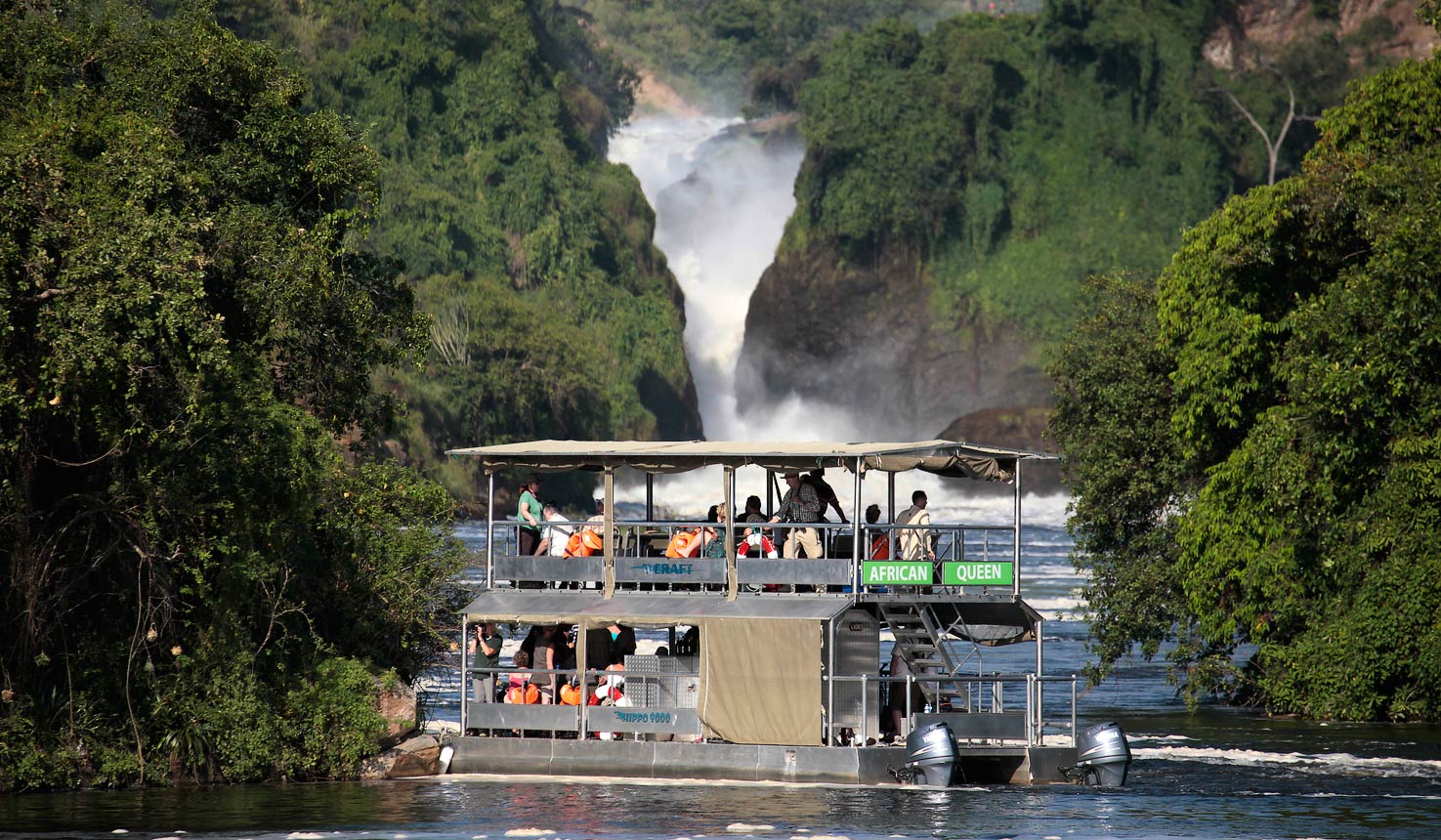
The morning begins at the falls themselves — one of the most powerful waterfalls in the world, where the entire volume of the Victoria Nile is compressed through a 7-metre-wide rock gorge before plunging 45 metres in a thundering cascade. The spray-drenched cliffs and surrounding riverine vegetation around the falls are highly productive for a distinctive microhabitat community: African black swift, Böhm's spinetail, and mottled spinetail hawk insects in the spray zone, while rock pratincoles rest on exposed midstream boulders with extraordinary sangfroid. The half-collared kingfisher — one of Uganda's most localized and sought-after waterway species — inhabits the rocky sections of the Nile near the falls.
A morning game drive through the north bank savannah — the most productive big-game and bird-viewing sector of Murchison — targets open-country savannah species: northern red-billed hornbill, African grey hornbill, black-and-white-casqued hornbill, abyssinian ground hornbill, standard-winged nightjar (in season), black-shouldered kite, grasshopper buzzard, red-throated bee-eater (nesting colonially in riverbank erosions), northern carmine bee-eater (in season), blue-breasted bee-eater, and a remarkable diversity of weavers, sparrows, and finches across the woodland and grassland transition zones.
Key Species: Rock pratincole, half-collared kingfisher, African black swift, red-throated bee-eater, northern carmine bee-eater, Abyssinian ground hornbill, standard-winged nightjar Meal Plan: Breakfast, Lunch, Dinner Accommodation: As Day 12
Day 14: Murchison Falls — Nile Boat Safari & Delta Birding
The crowning birding experience of the Murchison section of your 16-day Uganda birding safari is today's Nile boat safari — a journey upstream along the Victoria Nile from Paraa to the base of the falls, then downstream through the vast Nile Delta where the river enters Lake Albert.
The boat safari to the falls is one of Uganda's classic wildlife experiences — a close-range encounter with hippos, Nile crocodiles, and an extraordinary concentration of waterbirds along the river's forested banks and exposed sandbanks. For birders, the river's margins are extraordinarily productive: shoebill stork is regularly encountered in the delta and marsh sections of the lower Nile — making this one of the best alternative shoebill sites to Mabamba in Uganda. African skimmer — one of Africa's most graceful and most sought-after waterbirds, with its extraordinary laterite-coloured longer lower mandible that skims the water surface in flight — nests on sandbanks in the river and is reliably encountered. Goliath heron, black heron (using its remarkable umbrella-like wing-spreading hunting technique), saddle-billed stork, yellow-billed stork, openbill stork, and whale-headed stork (shoebill) are all possible along the river's length.
The Nile Delta where the river broadens and enters Lake Albert is one of Uganda's most important wetland birding sites — a vast, shallow, papyrus-fringed delta system supporting enormous concentrations of waterbirds including pink-backed pelicans in breeding colonies, long-tailed cormorants, African darters, pied kingfishers in their hundreds, and the critically important Albertine Rift endemic Shelley's oliveback in the delta's papyrus zone.
The afternoon offers an opportunity for a guided delta walk or additional game drive, targeting any remaining species on your Murchison list before departure the following morning.
Key Species: Shoebill (Nile Delta), African skimmer, saddle-billed stork, black heron, pink-backed pelican, African darter, Shelley's oliveback, goliath heron Meal Plan: Breakfast, Lunch, Dinner Accommodation: As Day 12
Day 15: Ziwa Rhino Sanctuary & Budongo Forest — Southern Return
Today's journey south returns you toward Entebbe with two outstanding birding stops that add important species to the trip list.
The Ziwa Rhino and Wildlife Ranch — the only place in Uganda where wild southern white rhinoceros can be seen, in a protected ranch environment that is the cornerstone of Uganda's rhino reintroduction programme — is primarily a mammal wildlife stop, but the open grassland, wetland, and woodland habitats of the ranch support excellent birding in their own right. African finfoot — one of Uganda's most localised and secretive waterway species — has been recorded in the ranch's stream and swamp sections. Denham's bustard, black-bellied bustard, African wattled lapwing, yellow-throated longclaw, and a variety of grassland cisticolas are regularly observed on the open ranch terrain.
The afternoon stop at Budongo Forest Reserve's Royal Mile — one of Uganda's most famous birding trails, a historically managed forest road through spectacular mahogany and ironwood forest — allows systematic coverage of Budongo's extraordinary bird community. The Royal Mile is one of the most reliable sites in Uganda for the Puvel's illadopsis, Ituri batis, yellow-footed flycatcher, forest robin, Cassin's grey flycatcher, Sabine's puffback, and — with exceptional patience and local knowledge — the nahan's francolin, one of Uganda's most wanted and most elusive forest birds.
Arrive back at your Entebbe accommodation in the early evening for a final dinner and overnight before departure.
Key Species: African finfoot, nahan's francolin, Puvel's illadopsis, Ituri batis, yellow-footed flycatcher, southern white rhino (mammal) Meal Plan: Breakfast, Lunch, Dinner Accommodation: Entebbe area hotel
Day 16: Final Entebbe Birding & Departure
Your final morning offers one last opportunity for birding before your departure flight — and in Uganda, even the last morning delivers.
A final walk through the Entebbe Botanical Gardens — established in 1898 and one of Uganda's most historically significant and ornithologically productive patches of lakeshore and forest vegetation — targets any remaining species on your trip list. The garden's lakeside vegetation regularly produces African pygmy kingfisher, woodland kingfisher, grey-headed kingfisher, African green pigeon, African grey parrot (in flight overhead), African emerald cuckoo, dideric cuckoo, little bee-eater, red-chested sunbird, olive sunbird, grey-headed sunbird, and the spectacular African paradise flycatcher. The lake margins hold long-tailed cormorant, African darter, pied kingfisher, and various heron species.
After a final coffee and a review of the trip list — which, across 16 days of systematic birding through Uganda's finest habitats, will comfortably exceed 500 species for attentive observers and may approach 600 species under excellent conditions with a specialist guide — your Ntungo Wildlife Safaris representative will transfer you to Entebbe International Airport for your onward flight.
You leave Uganda having experienced the full breadth of one of the world's great birding destinations — from the papyrus swamps of Mabamba to the montane forests of the Rwenzoris, from the Nile's waterway spectacle to the ancient depths of Bwindi. The shoebill has been found. The Albertine Rift endemics have been encountered. And Uganda — the Pearl of Africa — has delivered, as it always does, beyond all expectation.
Key Species: African grey parrot, African paradise flycatcher, African green pigeon, African pygmy kingfisher, woodland kingfisher Meal Plan: Breakfast Accommodation: N/A (departure day)
Safari Inclusions
-
- All airport transfers and ground transportation in a private 4WD safari vehicle throughout
-
- Professional specialist birding guide with expert knowledge of Uganda's avifauna
-
- Mabamba Swamp canoe excursion and community guide
-
- All accommodation on a full-board basis as per the meal plan
-
- Chimpanzee tracking permit (Kibale National Park)
-
- Gorilla trekking permit (Bwindi Impenetrable Forest)
-
- Kazinga Channel boat cruise (Queen Elizabeth NP)
-
- Nile boat safari (Murchison Falls NP)
-
- All national park and reserve entrance fees
-
- Bottled water throughout
What's Not Included
-
- International flights to and from Entebbe
-
- Uganda visa fees
-
- Comprehensive travel insurance (strongly recommended)
-
- Ziwa Rhino tracking fees
-
- Hot air balloon safari (available on request)
-
- Tips and gratuities for guides, trackers, and lodge staff
-
- Personal expenditure and bar bills
Practical Information for Birders
Species Expectations: A 16-day itinerary covering Uganda's major birding habitats with a specialist guide can realistically produce 500–620 species under good conditions. Albertine Rift endemics encountered on this itinerary typically number 25–35 of the 39 species.
Best Time for Birding: Uganda offers excellent birding year-round. The wet seasons (March–May and October–November) bring migratory species, active breeding behaviour, and the most vocal and visible forest birds. The dry seasons (June–September and December–February) offer easier access to some habitats and excellent general wildlife viewing alongside birding.
Equipment: Quality binoculars (8×42 or 10×42) are essential. A spotting scope is useful for open-country and waterway species. A quality camera with a minimum 500mm telephoto lens is recommended for forest and waterway species. Field guides recommended: Birds of East Africa (Stevenson & Fanshawe) and Birds of the African Rwenzori for montane specialists.
Physical Requirements: This itinerary involves forest walking on trails that can be steep, muddy, and physically demanding — particularly at Bwindi and the Rwenzoris. A reasonable level of fitness is recommended. All activities can be adapted to individual fitness levels with advance discussion.
To book your 16-day Uganda birding safari or to enquire about customised itineraries of different durations, species targets, or combined Uganda-Rwanda birding programmes, contact Ntungo Wildlife Safaris. Our specialist birding guides bring decades of field experience to every itinerary.
Where to Visit
-

Karibu KiliFair Experience
0 comments -
Nyungwe Forest National Park Rwanda
1 comments -
Ngorongoro Crater Tanzania
0 comments -
Serengeti National Park Tanzania
0 comments -

Mombasa
0 comments -
Lake Nakuru National Park
0 comments -
Masai Mara Safari Kenya
0 comments -
Kidepo Valley National Park
0 comments -
Bwindi Impenetrable National Park
0 comments -
Murchison Falls National Park
1 comments -
Lake Mburo national park
0 comments -
Akagera National Park
0 comments -
Queen Elizabeth National Park
1 comments