
Nyungwe Forest National Park: Rwanda’s Ancient Rainforest Kingdom
There is a forest in southwestern Rwanda that has been standing since before the last ice age.
While the glaciers advanced and retreated across the northern hemisphere, while the great grassland ecosystems of East Africa expanded and contracted with the shifting climate, while the Sahara transformed from savannah to desert and back again across geological timescales that dwarf human history — this forest stood. Unchanged in its fundamental character. Continuous in its canopy. Ancient in ways that the word ancient barely begins to capture.
Nyungwe Forest is estimated to be over two million years old — one of the oldest surviving forest ecosystems in Africa, a biological archive of extraordinary depth and richness whose unbroken continuity across geological time has allowed the accumulation of a biodiversity that is, in its concentration and its uniqueness, almost without parallel on the continent.
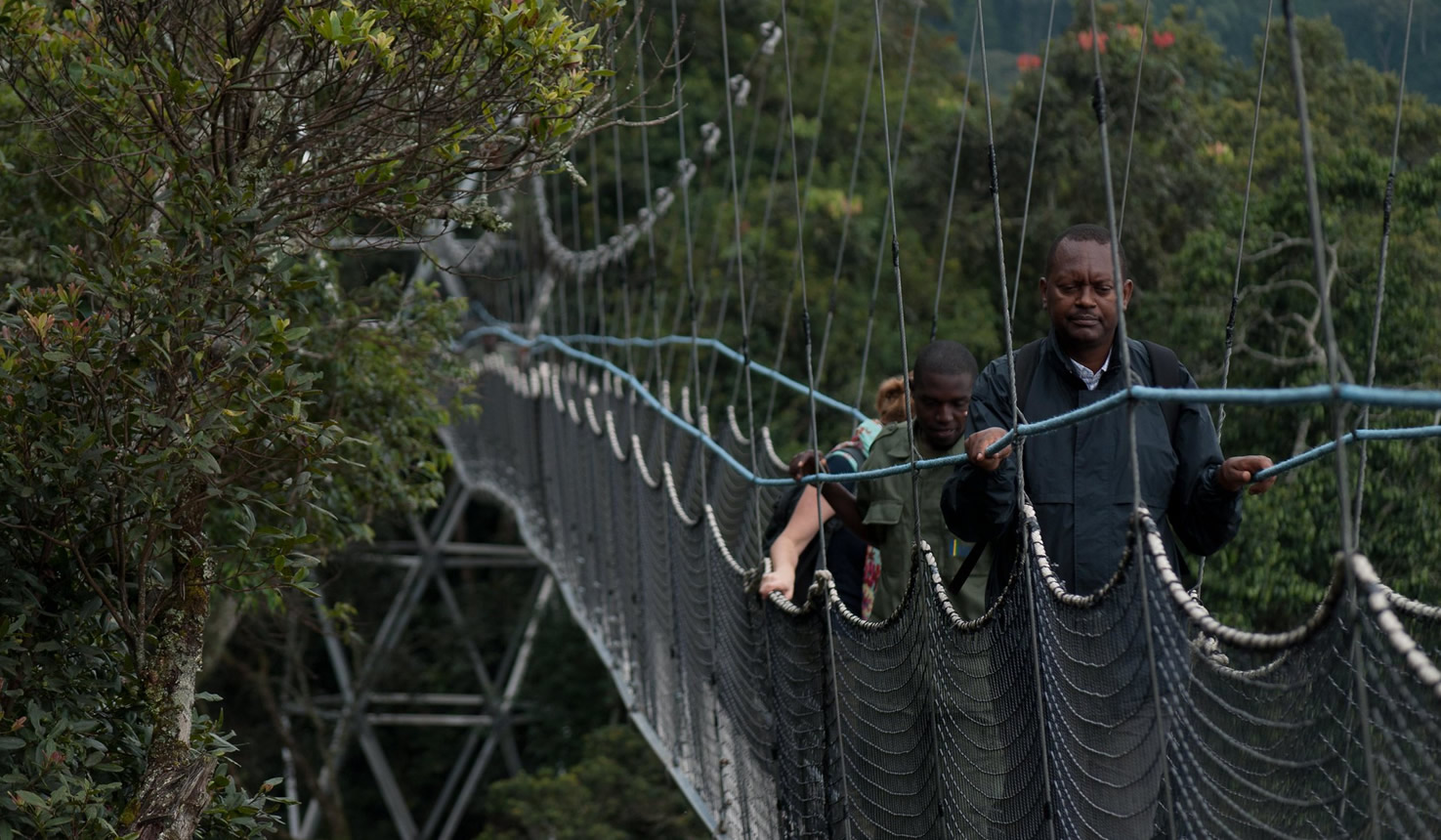
Standing at the edge of the canopy walkway in Nyungwe’s interior — the suspension bridge swaying gently beneath your feet, the ancient forest stretching in every direction below and around you, a troop of Ruwenzori black and white colobus monkeys moving through the canopy fifty metres away in a cascade of white fringe and acrobatic grace — you are standing in a place that has been precisely what it is for longer than our species has existed. The trees below you were old when the first humans walked upright on the African savannah. The primates in their canopy are the descendants of populations that have inhabited this forest without interruption for longer than evolutionary time can easily comprehend.
Nyungwe Forest National Park covers 1,019 square kilometres of montane rainforest in Rwanda’s southwestern corner — the largest remaining montane forest in Central Africa and one of the most important conservation areas on the continent. It is home to 13 primate species, over 300 bird species including 29 Albertine Rift endemics, hundreds of butterfly species, and a botanical diversity of extraordinary richness. It offers some of East Africa’s finest chimpanzee tracking, the most spectacular canopy walk in Rwanda, and a quality of ancient, immersive wilderness that is entirely distinct from any other experience in the country.
A visit to Nyungwe Forest with Ntungo Wildlife Safaris is not simply a wildlife experience. It is an encounter with deep time — and it will stay with you long after you leave.
The Forest: Understanding Two Million Years of Continuity
What Makes Nyungwe Ancient?
The concept of an ancient forest is more specific than it might first appear. Most forests in Africa — even large, apparently pristine ones — have been significantly disturbed, fragmented, or replaced by grassland at various points in the past two million years, particularly during the glacial periods when the African climate was cooler and drier and the extent of forest vegetation contracted dramatically.
Nyungwe survived these contractions. Its position in the Albertine Rift — the western arm of Africa’s Great Rift Valley, a region of exceptional topographic complexity whose varied elevation, aspect, and microclimate created refugia where forest could persist even when the surrounding landscape was becoming progressively drier — protected it from the climatic forces that eliminated or severely reduced forest cover across much of the continent.
This unbroken continuity is the source of Nyungwe’s extraordinary biodiversity. The species that live here today — the primates, the birds, the plants, the insects, the fungi — have had two million years of uninterrupted time to specialise, to diversify, to evolve into the niches that this specific forest environment provides. The result is an ecosystem of biological depth and uniqueness that no young forest — however large, however well-protected — can replicate.
The Forest Zones
Nyungwe’s 1,019 square kilometres encompass a range of altitude from approximately 1,600 metres at its lowest margins to 2,950 metres at its highest peaks — a vertical range that creates significant variation in temperature, rainfall, and vegetation character across the park’s extent.
The lower montane forest — the richest and most biologically productive zone — occupies the park’s mid-altitude areas and is the habitat of the majority of Nyungwe’s primate and bird species. The canopy here reaches 30 to 40 metres in height, with emergent trees rising above the general canopy level and creating the vertical structure that supports the extraordinary diversity of species distributed across different canopy layers.
The upper montane forest — above approximately 2,200 metres — transitions gradually toward a more open, mossy character: tree ferns, giant heathers, and dense mosses covering every surface in a landscape that feels distinctly different from the lush lower forest, more atmospheric, more enclosed, and in misty conditions almost otherworldly in its beauty.
The bamboo zone — occurring in patches across the park’s higher elevations — provides critical habitat for several of Nyungwe’s specialist species and creates a visual and acoustic environment entirely distinct from the broadleaved forest: the hollow percussion of bamboo stems moving in the wind, the dense, almost impenetrable quality of the bamboo interior, and the particular species — including the mountain gorilla in the few areas of suitable habitat — that depend on bamboo as a primary food source.
The Albertine Rift: A Global Biodiversity Hotspot
Nyungwe’s extraordinary biodiversity is not accidental — it is the product of the park’s position in the Albertine Rift, one of the world’s most important centres of biological endemism. The Albertine Rift — the western branch of the East African Rift system, running from Uganda’s Lake Albert in the north to Tanzania’s Lake Tanganyika in the south — is characterised by the combination of exceptional topographic complexity, high rainfall, and the geological instability that has created the isolation conditions for speciation across millions of years.
The Albertine Rift harbours 39 endemic bird species found nowhere else on earth, more Albertine Rift endemic bird species than any comparable area in Africa. It supports the highest primate diversity of any region in Africa. And it contains, in Nyungwe Forest and the adjacent Kibira Forest of Burundi (with which Nyungwe shares a continuous canopy in some areas), the largest remaining block of Albertine Rift montane forest — the habitat upon which the majority of these endemic species depend.
To visit Nyungwe is to visit the heart of one of the world’s most important biodiversity hotspots — and every bird, every primate, and every plant you encounter here is part of a biological story of extraordinary evolutionary significance.
Chimpanzee Tracking in Nyungwe: Into the Forest with our Closest Relatives
Nyungwe Forest National Park is one of East Africa’s finest destinations for wild chimpanzee tracking — an experience that combines the physical adventure of moving through ancient forest with the emotional and intellectual impact of encountering, at close range, the animal that shares more of our DNA than any other species on earth.
The Chimpanzees of Nyungwe
Nyungwe’s chimpanzee population is estimated at approximately 500 individuals — one of the largest remaining chimpanzee populations in Rwanda and one of the most significant in the broader Albertine Rift region. The population is organised into several communities that occupy different territories within the forest, and two of these communities — in the Cyamudongo sector and the main Nyungwe forest — have been habituated to human presence through years of patient, careful contact that has allowed the animals to become accustomed to human observers without altering their natural behaviour.
The Cyamudongo Forest — a small but extraordinary forest fragment connected to the main Nyungwe block — contains a habituated chimpanzee community that offers particularly reliable and particularly intimate tracking experiences. The forest’s smaller size means that the chimps’ movements are somewhat more predictable than in the vast main forest block, and the quality of encounter — in terms of proximity, duration, and behavioural observation — is consistently exceptional.
The Tracking Experience
Chimpanzee tracking in Nyungwe begins with an early morning briefing at the park headquarters — typically at Uwinka for the main forest community or at the Cyamudongo trailhead for the forest fragment community. Rwanda Development Board rangers divide visitors into small groups and provide detailed guidance on chimpanzee behaviour, tracking protocols, health requirements (respiratory illness can be transmitted to chimpanzees, whose immune systems are not adapted to human pathogens), and physical preparation for the trail.
The tracking itself is a genuine forest adventure — Nyungwe’s terrain is steep, the trails sometimes narrow and muddy, and the chimpanzees’ movement through the forest is rapid and unpredictable. Unlike mountain gorillas, which are relatively slow-moving and tend to stay within a defined area during the observation hour, chimpanzees cover ground at speed — swinging through the canopy, descending to the forest floor, calling across the forest in vocalisations of extraordinary volume and complexity, and occasionally moving in sudden bursts of speed that challenge observers to keep pace.
When the tracking team locates the chimpanzee community, the experience is immediately, viscerally electric. The noise alone is extraordinary — the chimpanzee community’s vocalisations, including the famous pant-hoot calls that carry for kilometres through the forest, create a soundscape of primal intensity that is unlike anything else in East African wildlife experience. The energy of the group — the social interactions, the dominance displays, the grooming sessions, the play of juveniles, the nursing of infants — creates a scene of biological richness and behavioural complexity that hours of observation barely begin to exhaust.
The proximity is genuinely remarkable. Habituated chimpanzees at Nyungwe have become accustomed to the presence of human observers to the point where the minimum required distance (typically 8 metres) is frequently reduced voluntarily by the chimpanzees themselves — individuals approaching the observation group out of curiosity, juveniles pausing to study the observers with the frank, unselfconscious interest of young animals encountering something new, and adult females moving through the group’s vicinity with the confident indifference of animals who have decided that human observers are neither a threat nor a significant source of interest.
The one hour permitted with the chimpanzee community passes with extraordinary speed — the complexity and energy of the encounter filling every minute with something new — and the return through the forest to the trailhead is invariably quieter and more reflective than the outward journey, the forest’s sounds and the morning’s memories combining in a quality of experience that most visitors describe as one of the most profound wildlife encounters of their lives.
Chimpanzee Trekking vs Habituation Experience
For visitors seeking an even more extended and more immersive chimpanzee experience, Nyungwe offers a chimpanzee habituation experience — a full-day programme that accompanies the Rwanda Development Board’s habituation team as they work with a partially habituated chimpanzee community, gradually extending the animals’ tolerance of human presence through regular, patient contact.
The habituation experience involves a full day in the forest (compared to the standard tracking experience’s one hour with the habituated community), following the partially habituated group through the forest as the team works to establish the trust that will eventually allow full habituation. The experience is physically more demanding and behaviourally more complex than the standard tracking encounter — the partially habituated animals are less predictable, more reactive to human presence, and more likely to display the full range of natural behaviours that a fully habituated community moderates in response to observer presence.
For visitors with a deeper interest in chimpanzee behaviour, conservation methodology, or the science of habituation, this experience provides an extraordinary window into both the lives of the chimpanzees and the extraordinary patient work of the researchers and rangers who are expanding Nyungwe’s habituated chimpanzee population.
The Canopy Walk: Nyungwe from Above
If the chimpanzee tracking experience takes you into the forest’s depths, the Igishigishigi Canopy Walk takes you above it — and the perspective it provides on Nyungwe’s ancient ecosystem is one of the most extraordinary and most memorable experiences available anywhere in Rwanda.
The Walk
The Igishigishigi trail begins at the Uwinka Visitor Centre — Nyungwe’s principal visitor facility, situated on a ridge with panoramic views across the forest canopy — and descends through increasingly dramatic forest terrain to the canopy walk structure. The name Igishigishigi refers to the giant tree ferns (Cyathea species) that line the trail — ancient, prehistoric-looking plants whose enormous fronds create a tunnel of green along the path and whose presence is a reminder of the forest’s extraordinary antiquity. Tree ferns are among the oldest plant forms on earth, their basic structure virtually unchanged for hundreds of millions of years, and walking through their fronds in Nyungwe’s misty forest creates an atmosphere of profound temporal displacement — as though the modern world has been temporarily suspended.
The trail descends gradually through the forest, crossing streams and passing through sections of particularly dense and beautiful forest, before reaching the canopy walk structure — a series of suspension bridges connecting elevated platforms built into the canopy trees at heights of up to 50 metres above the forest floor.
The Suspension Bridge Experience
The main suspension bridge stretches 160 metres between its anchor points in the canopy trees — a significant span that sways gently underfoot as you cross it, the forest floor invisible far below through the lattice of your footing, the canopy spreading away in every direction at eye level.
The view from the bridge is extraordinary. The Nyungwe canopy — seen from below, it appears as a more or less continuous green surface — reveals itself from above as a complex, three-dimensional world of immense complexity: different tree species at slightly different heights creating a mosaic of canopy texture and colour, the emergent trees rising well above the general canopy level with their upper branches hosting the largest birds and the most arboreal primate species, and the horizontal complexity of interlocking branches, hanging lianas, and epiphytic plants creating a habitat of extraordinary richness that is entirely inaccessible from the ground.
On clear days, the view extends across the canopy to the distant shores of Lake Kivu to the west — the lake’s great blue expanse visible through gaps in the forest, the hills of the Democratic Republic of Congo rising beyond it, and the whole scene creating a panoramic perspective on Rwanda’s southwestern landscape that few visitors ever experience.
Wildlife on the Canopy Walk
The canopy walk provides wildlife observation opportunities that ground-level forest exploration cannot — bringing the observer into the habitat zone that the majority of Nyungwe’s birds and arboreal mammals occupy permanently.
Ruwenzori black and white colobus monkeys — arguably Nyungwe’s most spectacular and most photogenic primate — are frequently observed from the canopy walk platforms and bridge. These extraordinary animals — with their long white fringe of hair dramatically contrasting with their jet black bodies — move through the canopy with the extraordinary grace of species perfectly adapted to arboreal life, their acrobatic leaps between trees carrying them distances that seem impossible for animals of their size. A colobus group in the canopy at eye level from the suspension bridge, their white fringes streaming behind them as they leap, is one of Nyungwe’s most magnificent wildlife sightings.
Forest birds are accessible from the canopy walk in ways that ground-level birding cannot match — sunbirds feeding at flowering epiphytes at eye level, warblers and flycatchers moving through the mid-canopy at viewing distance, and the various turacos whose vivid plumage is most fully visible from above the dense understorey that conceals them at ground level.
The morning light on the canopy — particularly in the first hour or two after sunrise when the mist is lifting and the light is finding its way through the canopy layers in brilliant shafts — creates photographic conditions of extraordinary beauty. The canopy walk is at its most atmospheric at this time of day, and arriving at the structure early — typically requiring a pre-dawn departure from your lodge — rewards visitors with a quality of light and atmosphere that the midday visit cannot provide.
Primates of Nyungwe: 13 Species in One Forest
The 13 primate species recorded in Nyungwe Forest National Park constitute one of the richest primate communities in Africa — a concentration of diversity that reflects the forest’s extraordinary antiquity, its ecological complexity, and its position in the Albertine Rift’s centre of primate endemism and speciation.
Ruwenzori Black and White Colobus Monkey
The Ruwenzori black and white colobus (Colobus angolensis ruwenzorii) is Nyungwe’s most spectacular primate and one of the most visually extraordinary animals in Africa. Endemic to the Albertine Rift and found nowhere else in the world outside this specific region, the Ruwenzori colobus is distinguished from other colobus subspecies by its particularly long and particularly dramatic white fringe — a cascade of white hair surrounding the face, extending along the sides of the body and across the tail, and contrasting with the jet-black body and face in a pattern of extraordinary visual impact.
Nyungwe is home to one of the largest remaining populations of Ruwenzori colobus in the world — estimated at over 400 individuals organised into large groups that can number over 300 individuals in a single troop, making them the largest primate groups in Africa outside of savannah baboon populations. Encountering a large colobus group in Nyungwe — dozens of animals moving through the canopy simultaneously, their white fringes catching the light, their calls echoing through the forest — is one of the most spectacular wildlife experiences in Rwanda.
L’Hoest’s Monkey
The L’Hoest’s monkey (Allochrocebus lhoesti) is one of Nyungwe’s most characteristic and most sought-after primates — a distinctive Albertine Rift endemic species with a dark grey-brown body, white bib, and a striking dark facial mask that gives it an appearance of considerable dignity and personality. L’Hoest’s monkeys are terrestrial in behaviour relative to many forest primates — spending significant time on the forest floor and in the lower undergrowth rather than the canopy — and their habit of foraging on the ground makes them more accessible to ground-level observers than the canopy-dwelling species.
Grey-Cheeked Mangabey
The grey-cheeked mangabey (Lophocebus albigena) — a large, dark, shaggy-coated monkey with a distinctive crest of long hair on its crown — moves through the middle and upper canopy of Nyungwe’s lower montane forest in groups of 15 to 30 individuals. Their loud, far-carrying calls — a series of deep whoops and gurgles — are one of the forest’s most distinctive sounds and serve as an effective acoustic location system for birders and primate trackers moving through the forest.
Olive Baboon
Olive baboons (Papio anubis) inhabit the forest margins and the more open sections of Nyungwe’s interior — their large size, bold character, and highly visible social interactions making them one of the park’s most easily observed primate species. Large troops move through the forest edge and adjacent tea plantation margins, their social dynamics — grooming, dominance interactions, infant play, and the complex negotiations of a hierarchically organised community — providing endlessly compelling behavioural observation for visitors willing to spend time in their company.
Other Primate Species
The remaining primate species of Nyungwe — including the blue monkey, red-tailed monkey, dent’s mona monkey, vervet monkey, potto, eastern needle-clawed bushbaby, and the mountain gorilla (present in small numbers in the bamboo zones of the park’s higher elevations) — represent a diversity of evolutionary lineages, ecological specialisations, and behavioural characters that makes Nyungwe one of Africa’s most remarkable primate destinations for the serious observer.
Birdwatching in Nyungwe: 300 Species and 29 Albertine Rift Endemics
For dedicated birders, Nyungwe Forest National Park is one of the most important and most rewarding destinations in East Africa — a site whose combination of forest antiquity, Albertine Rift position, and ecological complexity has produced a bird community of extraordinary diversity and exceptional endemism significance.
The Albertine Rift Endemics
The 29 Albertine Rift endemic bird species recorded in Nyungwe represent the core of the park’s ornithological significance — species found nowhere else on earth outside the Albertine Rift region, and in many cases nowhere else within the Rift as reliably and as accessibly as in Nyungwe.
Rwenzori turaco (Gallirex johnstoni) — one of the most spectacular birds in the Albertine Rift, a large forest turaco with vivid green and blue plumage, crimson wing patches visible in flight, and a call that is one of the most distinctive sounds of the montane forest. Present and regularly encountered in Nyungwe’s middle altitude forest.
Handsome francolin (Pternistis nobilis) — a large, beautifully patterned francolin of the Albertine Rift montane forest, encountered on the forest floor and in dense undergrowth. The male’s bold black, white, and chestnut plumage makes it one of the most attractive of Africa’s numerous francolin species and a priority target for birders visiting Nyungwe.
Rwenzori batis (Batis diops) — a tiny, exquisitely patterned flycatcher-like species of the montane forest canopy, found in mixed-species flocks that move through the upper forest levels. The male’s black, white, and rufous pattern makes it immediately recognisable when encountered in the flickering movement of a mixed-species flock.
Grauer’s warbler (Graueria vittata) — one of Africa’s most sought-after and most elusive forest warblers, a large, skulking species of dense undergrowth and bamboo that is more often heard than seen and that ranks among the most challenging of the Albertine Rift endemics to achieve a satisfactory observation.
Stripe-breasted tit (Melaniparus fasciiventer) — a distinctive small tit of the montane forest canopy, its bold streaked breast pattern and active, restless foraging behaviour making it one of the more accessible of the Albertine Rift endemics when located in the appropriate habitat.
Red-throated alethe (Chamaetylas poliophrys) — a beautiful, terrestrial thrush-like species of the forest floor, its combination of olive-brown upperparts and rich rufous throat making it one of the most attractive birds of the Nyungwe undergrowth.
Blue-headed sunbird (Cyanomitra alinae) — one of the most beautiful of Nyungwe’s numerous sunbird species, the male’s combination of metallic blue-green head, olive back, and yellow underparts making it immediately distinctive and a source of considerable photographic delight when encountered feeding at flowering trees along the forest trails.
Other Forest Bird Highlights
Beyond the Albertine Rift endemics, Nyungwe’s broader bird community includes a remarkable diversity of forest specialists:
African green broadbill (Pseudocalyptomena graueri) — one of the most sought-after birds in East Africa, a tiny, jewel-green species of the montane forest canopy found reliably only in the Albertine Rift and numbering among the most visually extraordinary birds on the continent.
Purple-breasted sunbird (Nectarinia purpureiventris) — a spectacular large sunbird with iridescent purple breast and metallic green upperparts, encountered feeding at flowering forest trees and epiphytes throughout Nyungwe’s middle and upper forest zones.
Strange weaver (Ploceus alienus) — a peculiar and genuinely strange weaver of the Albertine Rift montane forest, its odd combination of plumage characters and its exclusively forest habitat making it one of the most unexpected birds for visitors accustomed to the open-country weavers of the savannah.
Mountain masked apalis (Apalis personata) — a small, active warbler of the upper montane forest, its black mask and white underparts making it immediately recognisable when it pauses briefly in the canopy foliage.
Dusky crimsonwing (Cryptospiza jacksoni) — a beautiful small finch of the forest floor and dense undergrowth, the male’s deep crimson plumage making it one of the most vivid colour surprises of the Nyungwe forest interior.
Birding the Nyungwe Trails
Nyungwe’s extensive trail network — over 130 kilometres of maintained trails through different sections of the park — provides systematic access to the forest’s different habitat zones and their respective bird communities. Several trails are particularly productive for specific species groups:
The Karamba Trail — a longer trail through the lower montane forest zone, excellent for L’Hoest’s monkeys, grey-cheeked mangabeys, and the lower-altitude forest bird community including several of the Albertine Rift endemics.
The Igishigishigi Trail — the canopy walk trail, excellent for colobus monkeys, forest raptors, and the canopy-level bird species accessible from the elevated bridge platforms.
The Bigugu Trail — leading to Nyungwe’s highest accessible peak at approximately 2,950 metres, excellent for upper montane forest species including the montane sunbirds, highland cisticolas, and the bamboo zone specialists.
The Kamiranzovu Trail — leading through the park’s spectacular Kamiranzovu Marsh — a highland swamp of extraordinary beauty surrounded by montane forest — excellent for marsh-associated species including the globally threatened Grauer’s rush warbler (Bradypterus graueri), one of the most sought-after birds in the entire Albertine Rift.
The Kamiranzovu Marsh: Nyungwe’s Hidden Wonder
Deep within Nyungwe’s interior, accessible via a full-day guided hike of considerable physical demand but extraordinary reward, the Kamiranzovu Marsh is one of Rwanda’s most beautiful and most biologically significant wetland habitats — a highland swamp of approximately 1,000 hectares surrounded by montane forest at an altitude of approximately 2,100 metres.
The marsh is fed by the springs and rainfall of the surrounding highland forest and supports a community of highly specialised marsh and swamp vegetation — sedges, rushes, papyrus, and the extraordinary Lobelia wollastonii (giant lobelia) whose tall, candelabra-like flowering spikes rise metres above the marsh surface in one of the most dramatic botanical spectacles in Rwanda.
The Kamiranzovu Marsh is the primary Rwandan site for the critically endangered Grauer’s rush warbler — a tiny, brown, skulking warbler of papyrus and sedge marshes that is one of the most range-restricted and most conservation-threatened birds in the Albertine Rift, its global population estimated at fewer than 1,500 individuals and declining due to wetland drainage and habitat degradation across its limited range. Nyungwe’s Kamiranzovu Marsh is one of the most reliable sites in the world for this species, and for dedicated birders the hike to the marsh is among the most important and most rewarding single birding experiences available in Rwanda.
Beyond the Grauer’s rush warbler, the marsh supports African snipe, African water rail, lesser moorhen, little rush warbler, and various other wetland species — a bird community entirely distinct from the surrounding forest and providing a remarkable contrast to the forest birding of the approach trail.
The hike to Kamiranzovu is long — typically 4 to 6 hours return depending on pace — and physically demanding on trails that can be steep, muddy, and genuinely challenging in wet conditions. It is one of Nyungwe’s most rewarding experiences for those willing to invest the physical effort, and the combination of forest hiking, wildlife observation, and the marsh’s extraordinary botanical landscape creates a day of safari adventure that stands entirely on its own merits.
Tea Plantations: The Human Landscape at Nyungwe’s Edge
The landscape surrounding Nyungwe Forest is one of Rwanda’s most distinctive and most photographed — a vast, manicured expanse of tea plantations that covers the hills immediately adjacent to the national park in an almost continuous green carpet of carefully tended tea bushes, their neat rows following the contours of the hills in patterns of extraordinary visual regularity.
Rwanda is one of East Africa’s most important tea producing countries — the highland climate of the southwestern region, with its reliable rainfall, cool temperatures, and rich volcanic soils, creates ideal conditions for the cultivation of high-quality tea, and the estates surrounding Nyungwe are among the most productive in the country.
The tea plantations serve as a visual and ecological buffer between the national park’s ancient forest and the agricultural and settlement landscape of the broader region. They are not wilderness, but they are beautiful — the vivid green of the tea bushes against the darker green of the forest behind them, the workers moving through the rows with their traditional baskets, and the distant views across the plantation landscape to Lake Kivu and the hills of the DRC creating a scene of considerable human and natural beauty.
The Gisakura Tea Estate — adjacent to the park’s principal visitor facilities at Gisakura — offers guided tea estate walks that provide an excellent introduction to the cultivation, processing, and tasting of Rwanda’s famous tea. The walk through the plantation, the visit to the processing factory, and the concluding tea tasting with estate-produced tea combine into a genuinely rewarding cultural and agricultural experience that complements the wildlife activities of the park itself.
The tea plantation landscape also supports its own wildlife community — particularly birds of the forest edge and open country that use the plantation’s structure for feeding and nesting. Sunbirds visit the plantation’s flowering shrubs. Cisticolas inhabit the grass margins between tea rows. African harrier-hawks patrol the plantation edge. And the contact zone between the plantation and the forest margin — the most ecologically productive transition zone in any landscape — is frequently productive for species that use both habitats at different times of day or in different seasons.
The Cyamudongo Forest: Nyungwe’s Little Sister
Approximately 10 kilometres from the main Nyungwe Forest block, separated by agricultural land and tea plantation but connected by an important wildlife corridor, the Cyamudongo Forest is a small but extraordinarily productive forest fragment of approximately 1,000 hectares that serves as the home of one of Nyungwe’s most accessible and most reliably tracked habituated chimpanzee communities.
Cyamudongo’s small size is both its limitation and its advantage for wildlife visitors: the forest’s compact extent means that the chimpanzee community’s movements are more predictable and the tracking experience more reliably productive than in the vast main forest block, where the chimps’ wide ranging movements can make tracking more challenging and the time to encounter more variable.
The Cyamudongo Forest also holds its own complement of forest birds — several Albertine Rift endemics are regularly recorded in the fragment, and its forest edge character makes it particularly productive for the species that prefer the transition between closed forest interior and more open forest margin habitat.
A visit to Cyamudongo is most commonly combined with the main Nyungwe tracking programme as a two-day chimpanzee experience — tracking in the main forest on day one and in Cyamudongo on day two, or vice versa — providing both the scale and atmosphere of the main forest and the intimacy and accessibility of the forest fragment.
Lake Kivu: The Perfect Nyungwe Complement
Nyungwe Forest National Park and Lake Kivu are two of Rwanda’s finest and most complementary destinations — and their proximity (the lake’s eastern shore is approximately 30 to 45 minutes from the park’s main visitor facilities) makes combining them into a single southwest Rwanda itinerary both logical and enormously rewarding.
Lake Kivu — one of Africa’s Great Lakes, straddling the border between Rwanda and the Democratic Republic of Congo — is a lake of extraordinary beauty: its deep blue waters surrounded by steep, terraced hills whose lower slopes meet the lakeshore in a series of small beaches, fishing villages, and resort towns. The lakeside town of Gisenyi (Rubavu) in the north and Kibuye (Karongi) in the centre offer comfortable accommodation, boat cruises, and the relaxed pleasure of the lake’s warm-water environment after the exertion of Nyungwe’s forest trails.
A typical Nyungwe and Lake Kivu itinerary combines 2 to 3 nights in or adjacent to the forest — allowing chimpanzee tracking, the canopy walk, and a forest bird walk — with 1 to 2 nights on the lake shore, providing rest, boat cruises, and the sensory contrast of the open lake after the enclosed, immersive forest.
Accommodation in and Around Nyungwe Forest
Midrange
Top View Hill Hotel — Situated on the ridge above the Gisakura tea estate with sweeping views across the plantation and the forest, Top View Hill Hotel offers comfortable accommodation, reliable food, and the most convenient possible access to Nyungwe’s visitor facilities. A solid, well-positioned midrange option that delivers good value for its location.
Gisakura Guest House — The most affordable accommodation option near the park, Gisakura Guest House provides basic but clean and comfortable rooms within walking distance of the park’s main entrance and visitor centre. Ideal for budget-conscious visitors who want to prioritise spending on activities rather than accommodation.
Nyungwe Top View Hill Hotel — Offering comfortable rooms with forest and plantation views, this property provides a reliable midrange base for Nyungwe activities at a reasonable price point.
Midrange Nyungwe safari from USD 350 per person per night, including accommodation, chimpanzee tracking permit, canopy walk fee, and guided trail.
Luxury
One&Only Nyungwe House — Nyungwe’s most celebrated and most spectacular accommodation property — a converted tea plantation manor house of extraordinary elegance, set within the Gisakura Tea Estate directly adjacent to the national park. The property’s combination of colonial-era architectural character, magnificent grounds, outstanding food, exceptional service, and seamless access to the park’s activities makes it one of the finest boutique hotels in Rwanda.
The One&Only Nyungwe House offers 22 individually designed rooms and suites, each with private veranda overlooking the tea plantation or the forest beyond. The property’s swimming pool — positioned at the plantation’s edge with the forest as its backdrop — is one of the most dramatically situated hotel pools in East Africa. And the quality of the guiding programme, developed in partnership with Rwanda Development Board and Nyungwe’s specialist wildlife team, ensures that every activity — chimpanzee tracking, canopy walk, birding walk, tea estate tour — is conducted with the expertise and attentiveness that the property’s luxury positioning demands.
Luxury Nyungwe safari from USD 1,200 per person per night at One&Only Nyungwe House, including accommodation, private guiding, chimpanzee tracking, canopy walk, and all meals.
Practical Information for Nyungwe Forest
Chimpanzee Tracking Permits: Permits for chimpanzee tracking in Nyungwe Forest must be booked in advance through the Rwanda Development Board. The standard tracking experience allows one hour with the habituated community. The habituation experience (full day) is available at a premium and must be booked well in advance. Permits are included in all Ntungo Wildlife Safaris Nyungwe packages.
Physical Requirements: Chimpanzee tracking in Nyungwe involves hiking on trails that can be steep, muddy, and physically demanding. A reasonable level of fitness is recommended. The canopy walk involves an uphill hike to the suspension structure and requires a reasonable head for heights. The Kamiranzovu Marsh trail is a serious full-day hike recommended only for physically fit visitors with a genuine commitment to the experience.
What to Wear: Long trousers and long-sleeved shirts protect against vegetation and insects. Waterproof hiking boots are essential — the forest trails can be muddy year-round. A waterproof jacket or poncho is strongly recommended. Garden gloves are useful for pushing through dense undergrowth on some trails.
Best Time to Visit: Nyungwe can be visited year-round. The dry seasons (June–September and December–February) offer the most comfortable hiking conditions and generally clearer visibility across the canopy and toward Lake Kivu. The wet seasons (March–May and October–November) bring heavy afternoon rain but lush, vivid forest conditions and excellent birdlife. The forest is genuinely beautiful in all seasons — Nyungwe in the mist is one of Rwanda’s most atmospheric and most photographically rewarding landscapes.
Getting There: Nyungwe Forest is approximately 220 kilometres southwest of Kigali — a 3 to 4 hour drive along a good road that passes through Rwanda’s spectacular southern highlands, the tea estates of the southwest, and the shores of Lake Kivu. The drive itself is one of Rwanda’s most scenic and most rewarding journeys, with numerous stops for views and photography.
Combining Nyungwe with Other Rwanda Destinations
Nyungwe + Volcanoes National Park (Gorilla Trekking): Rwanda’s two signature wildlife experiences — chimpanzee tracking in the ancient southern rainforest and mountain gorilla trekking in the northern volcanic highlands — combined in a single Rwanda itinerary. Typically 2 nights at Nyungwe followed by 2 nights at Volcanoes, connected via Kigali or on the longer but more scenic direct route through the southwest.
Nyungwe + Lake Kivu: As described above — the forest’s ancient, immersive wilderness experience combined with the lake’s beauty, boat cruises, and lakeside relaxation. One of Rwanda’s most satisfying short itineraries.
Nyungwe + Akagera + Volcanoes: The complete Rwanda wildlife circuit — southern rainforest, eastern savannah Big Five, and northern gorilla trekking — covering the full geographic and ecological range of Rwanda’s extraordinary wildlife heritage in a single comprehensive itinerary.
Nyungwe + Bwindi (Uganda): For travellers combining Rwanda and Uganda, the route between Nyungwe and Bwindi Impenetrable Forest crosses the southwestern corner of Rwanda — a journey of approximately 3 to 4 hours through the border town of Kisoro — making a combined Nyungwe chimpanzee and Bwindi gorilla itinerary both logistically straightforward and ecologically compelling.
Why Nyungwe Deserves a Place at the Centre of Every Rwanda Itinerary
Rwanda’s wildlife narrative has long been dominated by a single, incomparably powerful story: the mountain gorillas of Volcanoes National Park. And that story deserves every superlative it receives — gorilla trekking in Volcanoes is one of the most extraordinary wildlife experiences on earth.
But Rwanda is more than its gorillas. And Nyungwe Forest — ancient, vast, extraordinarily biodiverse, ecologically unique, and home to a wildlife experience of its own that stands entirely on its own merits — is the most compelling evidence of that larger truth.
The chimpanzees of Nyungwe are not a consolation prize for travellers who cannot afford a gorilla permit. They are a world-class primate encounter in their own right — dynamic, electric, behaviourally complex, and emotionally affecting in ways that are entirely distinct from the gorilla experience and entirely equal to it in their impact.
The canopy walk is not a theme park attraction. It is a genuinely extraordinary encounter with one of Africa’s most ancient and most biologically significant ecosystems — seen from a perspective that almost no human being has ever experienced.
The forest itself — two million years old, continuous, teeming with life at every level from the forest floor to the emergent canopy — is one of the natural world’s great treasures: a place whose continued existence is both a remarkable piece of good fortune and a responsibility of the highest order.
Come to Rwanda for the gorillas. Stay for Nyungwe. Leave with the full story of what this extraordinary country has to offer.
The ancient forest is waiting. The chimpanzees are calling. The canopy is above you.
Contact Ntungo Wildlife Safaris to incorporate Nyungwe Forest National Park into your Rwanda safari itinerary — as a standalone forest experience, combined with Lake Kivu, or as part of a complete Rwanda wildlife journey connecting Nyungwe with Volcanoes National Park and Akagera. We offer itineraries across all accommodation tiers with expert guiding, chimpanzee tracking permit reservation, and seamless logistics throughout Rwanda.
📩 info@ntungosafaris.com 🌐 www.ntungosafaris.com 📞 +256 771 399299 / +256 706 772990
One&Only Nyungwe House — Nyungwe’s finest accommodation property — books up significantly in advance. Early reservation is strongly recommended, particularly for peak season travel between June and September.

[…] is where Ntungo Wildlife Safaris comes […]