Serengeti National Park: The Endless Plains of Tanzania
There is a word in the Maasai language — siringet — that means the place where the land runs on forever. The people who gave this name to the landscape they had inhabited for centuries were not speaking poetically. They were speaking with the literal accuracy of people who had walked every inch of it and knew exactly what they were describing.
The Serengeti is the place where the land runs on forever.
Standing on the open plains of Tanzania’s most celebrated national park — the grass stretching to every horizon, the sky enormous above, a distant kopje rising from the flatness like a forgotten island — you understand immediately why this landscape has captured the human imagination more completely than almost any other place on earth. There is something in the scale of it, in the quality of the light, in the way the wind moves through grass that seems to extend without boundary in every direction, that connects you to something older and deeper than ordinary travel experience.
And then the wildebeest appear. First a few, then hundreds, then thousands, then a number beyond counting — a living, moving, breathing river of animals that extends from the horizon behind you to the horizon ahead, their collective calling a sound that you feel as much as hear, their hooves on the baked earth a vibration that rises through the ground and into your body.
This is the Great Serengeti. And nothing — no documentary, no photograph, no account however vivid — prepares you for the reality of being inside it.
Serengeti National Park covers approximately 14,763 square kilometres of northern Tanzania — an area roughly the size of Northern Ireland or the state of Connecticut — and forms the core of the larger Serengeti ecosystem, which together with Kenya’s Masai Mara, the Ngorongoro Conservation Area, and several surrounding game reserves and conservancies protects one of the last truly intact large-mammal ecosystems remaining on the planet. The park was designated a UNESCO World Heritage Site in 1981, recognised for its extraordinary natural beauty and its exceptional importance as the stage for the most spectacular animal migration in the world.
A Serengeti safari with Ntungo Wildlife Safaris is not simply a game drive. It is an immersion in a living, breathing, ancient ecosystem that operates on scales of time and space that human civilisation rarely encounters. Come prepared to be humbled — and to leave transformed.
The Landscape: Five Ecosystems in One Park
The Serengeti’s reputation for open, featureless grassland is only partially accurate — and visitors who understand the park’s genuine ecological diversity arrive better prepared to appreciate the full range of what it offers.
The Short-Grass Plains: The Serengeti’s Southern Heart
The short-grass plains of the southern and southeastern Serengeti — stretching from the Ngorongoro Conservation Area boundary northward toward Seronera — are the landscape most closely associated with the Serengeti in the global imagination. These are the Serengeti plains of the documentaries: open, flat, almost treeless, their grass cropped short by the enormous herbivore populations that graze them, their surface punctuated only by the scattered granite kopjes that rise from the flatness like geological afterthoughts.
The short-grass plains are the calving grounds of the wildebeest migration — the area where, between January and March, the herds congregate in their millions and the extraordinary annual drama of mass calving takes place. They are also the habitat of the Serengeti’s cheetah populations — the open terrain providing both the visibility for hunting and the speed corridor that allows the cheetah’s explosive acceleration to be deployed to full effect.
During the migration season, the short-grass plains are covered by wildebeest herds of extraordinary density — a living carpet of animals that stretches beyond visual range in every direction and creates an experience of biological abundance that has no equivalent anywhere else on earth.
The Central Serengeti: Seronera and the Kopjes
The central Serengeti around the Seronera Valley — the park’s operational heart and the location of most of its internal infrastructure — is where the Serengeti’s ecological diversity reaches its greatest concentration. The Seronera Valley is a year-round water source that attracts and retains wildlife throughout the seasonal cycle, and the combination of the permanent Seronera River, the varied terrain of the surrounding area, and the extraordinary kopje formations that punctuate the central plains creates one of the most productive and most diverse wildlife areas in Africa.
The kopjes — pronounced koppies, from the Afrikaans for small heads — are ancient granite outcroppings that protrude through the overlying soil and sediment of the plains, their surfaces shaped by millions of years of weathering into extraordinary forms: smooth domes, balanced boulders, creviced towers, and cave-like overhangs that provide shelter, vantage points, and territorial markers for a remarkable community of species. Lion prides use the kopjes as the permanent anchors of their territories — generations of the same family resting on the same rocks, marking the same boulders with scent, hunting the same surrounding plains that their grandmothers hunted before them. Leopards inhabit the fig and sausage trees that grow in the kopjes’ sheltered crevices. Rock hyrax colonies occupy every available rocky surface, their alarm calls warning of approaching predators. Klipspringers stand on the highest points of the kopjes with extraordinary poise. And Verreaux’s eagle and augur buzzard soar above them, riding the thermals that rise from the sun-heated rock.
The Western Corridor: The Grumeti River
The western corridor of the Serengeti — a narrow arm of protected land extending westward toward Lake Victoria — contains the Grumeti River, one of the migration’s two principal river crossing obstacles. The Grumeti is a smaller river than the Mara, but it harbours some of the largest Nile crocodiles in East Africa — enormous, ancient individuals that can exceed five metres in length and that wait with terrible patience for the migration herds to arrive at the crossing points between May and July.
The western corridor is significantly less visited than the central and northern Serengeti — its remoteness from the park’s main access points means that game drives here have a quality of solitude and exclusivity that is increasingly rare in popular safari destinations. The wildlife is excellent, the vegetation more varied than the open plains, and the Grumeti River crossing — while less famous than the Mara crossings further north — can be extraordinarily dramatic when the migration herds are present.
The Northern Serengeti: The Mara River and the Migration’s Apex
The northern Serengeti — the sector of the park closest to the Kenyan border and the Masai Mara — is where the migration reaches its most dramatic and most internationally celebrated moment. The terrain here is different from the open plains of the south: gently rolling, more varied, punctuated by small rivers, occasional hills, and the spectacular Lobo and Nyati kopjes that rise dramatically from the surrounding landscape.
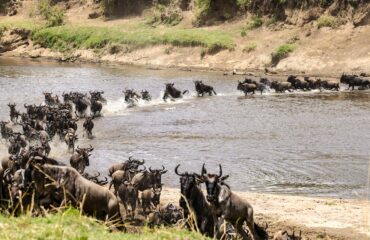
The Mara River forms the northern boundary of the Serengeti, crossing into Kenya’s Masai Mara beyond the park boundary, and it is here — at the principal river crossing points between the Tanzanian and Kenyan sides of the ecosystem — that the migration crossings occur in their most spectacular form between July and October.
The northern Serengeti receives substantially fewer visitors than the central and southern sectors, its distance from the park’s main gates creating a natural barrier that self-selects for more experienced and more committed safari travellers. The reward for the extra distance is an experience of the Serengeti at its most exclusive — game drives with few or no other vehicles, wildlife encounters of extraordinary intimacy, and the particular quality of attention that comes from being in a vast landscape without the distraction of other vehicles competing for the same sighting.
The Ndutu Area: Gateway to the Calving Season
The Ndutu area — technically within the Ngorongoro Conservation Area but ecologically and experientially part of the Serengeti system — is the southernmost section of the greater Serengeti ecosystem and the principal calving ground of the wildebeest migration. Between January and March, as the short rains green the southern plains and the wildebeest herds concentrate in their millions, the Ndutu area becomes the stage for one of the most remarkable events in the natural world: the mass calving season.
Approximately 500,000 wildebeest calves are born within a period of just three to four weeks — a biological strategy known as predator swamping, in which the simultaneous production of enormous numbers of vulnerable young animals overwhelms the capacity of the predator community to take a significant proportion. The calving plains are simultaneously a nursery of extraordinary tenderness — newborn calves standing within minutes of birth, taking their first tentative steps on legs that seem impossibly long and uncertain — and a hunting ground of breathtaking predatory intensity, as the Serengeti’s lions, cheetahs, leopards, hyenas, and wild dogs capitalise on the abundance of vulnerable prey.
The Ndutu calving season is one of East Africa’s most extraordinary wildlife experiences — a spectacle of life, death, and the relentless forward momentum of biological existence that is as profound in its emotional impact as any wildlife encounter in Africa.
The Great Migration: The Serengeti’s Defining Story
The Great Wildebeest Migration is the largest overland animal migration on earth and the ecological event around which the entire Serengeti ecosystem is organised. Understanding it — not just as a spectacle to be witnessed at a single dramatic moment, but as a continuous, year-round process that shapes the entire Serengeti experience — is essential for getting the most from a Serengeti safari.
The Numbers
- 1.5 million wildebeest (Connochaetes taurinus)
- 400,000 Burchell’s zebra (Equus quagga)
- 200,000 Thomson’s gazelle (Eudorcas thomsonii)
- Total annual distance covered: approximately 3,000 kilometres
- Total ecosystem area: approximately 40,000 square kilometres
These are the participants in the migration — and the numbers, while impressive on paper, only acquire their full meaning when you are standing in the middle of a herd that extends beyond visual range in every direction.
The Annual Cycle
The migration follows a broadly clockwise circuit around the Serengeti-Mara ecosystem, driven by the seasonal rains and the growth of the fresh grass that the herds must follow to survive. The circuit is not a simple loop — it is a dynamic, continuously adjusting response to rainfall patterns that vary from year to year, and its precise timing and geography change accordingly. What follows is a general guide:
January — March: The Southern Plains and the Calving Season
The herds are concentrated on the short-grass plains of the southern Serengeti and the Ndutu area, drawn by the nutritious grass that grows here during and after the short rains. This is the calving season — the most biologically intense period of the migration’s annual cycle, with half a million calves born in the space of a few weeks and the predator community operating at maximum intensity. The short-grass plains in January and February are one of the most extraordinary wildlife environments on earth — wildebeest herds covering the landscape from horizon to horizon, newborn calves taking their first steps, cheetahs and lions hunting in the open where every pursuit is visible from beginning to end.
April — May: The Long Rains and the Northward Movement
As the long rains arrive and the short-grass plains become saturated, the herds begin their northward movement — a broad, loosely organised drift that gradually concentrates into more defined columns as the animals move toward the central Serengeti and the Seronera Valley. This is one of the Serengeti’s less visited periods — the rain can make some tracks challenging — but the green, luminous landscape and the enormous moving herds create a photographic and experiential environment of extraordinary beauty for visitors willing to embrace the wet season.
June — July: The Central Serengeti and the Western Corridor
The herds move through the central Serengeti and the western corridor in June and July, with significant concentrations around the Seronera Valley and the Grumeti River. The Grumeti crossings — smaller and less publicised than the Mara crossings but harbouring some of the largest crocodiles in Africa — begin to occur as the leading edge of the migration reaches the western corridor. The central Serengeti in June and July combines excellent migration herds with the full complement of the park’s resident wildlife — one of the most comprehensively productive periods in the Serengeti calendar.
August — October: The Northern Serengeti and the Mara River
The migration’s northern push — driven by the dry season’s gradual depletion of the central Serengeti’s grass — brings the herds northward through the Loliondo and Lobo areas toward the Mara River. This is the period of the famous Mara River crossings — the most dramatic single spectacle of the migration and the event that has made the Serengeti-Mara ecosystem world-famous. The crossings occur as the migration herds encounter the river’s barrier and must cross into Kenya’s Masai Mara to access fresh grazing, then recross southward as the short rains begin.
The northern Serengeti between August and October offers some of the finest safari experiences in East Africa: the crossing drama, the resident wildlife of the northern sector, the low visitor density, and the extraordinary landscape of the Mara River valley all combining to create a safari of exceptional quality.
November — December: The Return South
As the short rains begin in November, greening the southern plains and triggering the grass growth that will support the calving season, the herds begin their return southward — a broad movement that reverses the northward drift of the preceding months and deposits the animals back on the southern plains in time for the calving season to begin again in January. The return south is a quieter, less dramatic phase of the migration than the calving season or the river crossings, but the sight of enormous herds moving purposefully across the Serengeti landscape in the fresh green of the short rains is beautiful and moving in its own understated way.
Wildlife Beyond the Migration: The Serengeti’s Resident Community
The Great Migration dominates the Serengeti’s reputation — but the park’s extraordinary wildlife extends far beyond the migrating herds and their attendant predators. The Serengeti’s resident wildlife community is remarkable in its own right and ensures that every Serengeti safari, regardless of season, delivers wildlife experiences of the highest quality.
Lions
The Serengeti National Park supports an estimated 3,000 lions (Panthera leo) — one of the largest lion populations in Africa and the most studied in the world. The Serengeti Lion Project, established in 1966 by the pioneering researcher George Schaller and continued by Craig Packer and his colleagues for over five decades, has produced the most comprehensive long-term study of lion behaviour, ecology, and population dynamics ever conducted, and the insights it has generated have shaped our understanding of lion society in ways that extend far beyond the Serengeti itself.
The Serengeti’s lions are organised into prides — social groups of related females, their cubs, and associated adult males — whose territories are defined by the landscape’s features: the kopjes that serve as territory markers, the river courses that provide boundaries, and the prey populations that determine the minimum viable territory size. A single Serengeti lion pride may hold a territory of 50 to 400 square kilometres, depending on prey density and the competitive landscape of the surrounding pride system.
Encounters with Serengeti lions are among the most reliable and most spectacular in Africa. The park’s habituation of its lion population to vehicle presence — accumulated over decades of scientific research and safari tourism — allows extraordinary close observation of natural behaviour: dawn hunts on the short-grass plains, pride interactions at kopje resting sites, territorial boundary marking, and the endlessly compelling social dynamics of a family group that has shared the same landscape for generations.
Leopards
The leopard (Panthera pardus) is the Serengeti’s most elusive and most independently magnificent predator — a solitary, cryptic, and nocturnal hunter that conceals itself so effectively in the riverine forest and kopje vegetation that its presence in a landscape is often suspected long before it is confirmed. The Serengeti’s leopard population inhabits the riverine forest along the Seronera, Grumeti, and Mara rivers, the fig and sausage trees of the kopje systems, and the rocky ridgelines of the northern sector.
Finding a leopard in the Serengeti requires a combination of local knowledge, patience, and the kind of attentive, systematic observation of the environment that distinguishes an expert guide from a competent one. The reward — a leopard draped along a fig tree branch above the river, a kill cached in the fork of a sausage tree, or a female moving through the long grass in the last light of the afternoon — is one of the Serengeti’s most coveted and most photographic wildlife moments.
Cheetahs
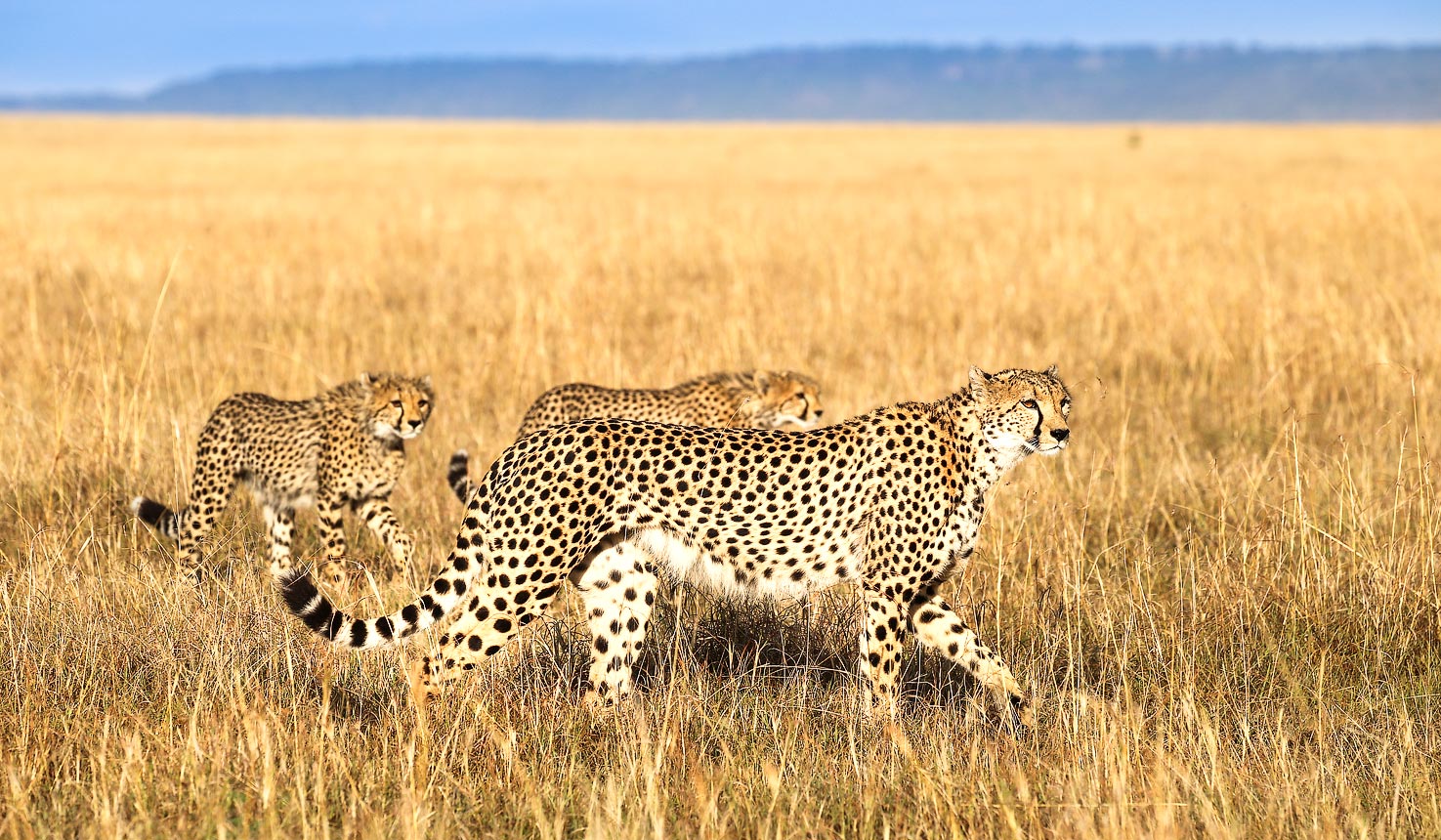
The cheetah (Acinonyx jubatus) is the Serengeti’s most visible and most behaviourally dynamic large cat — its preference for open grassland terrain, its diurnal hunting activity, and the extraordinary spectacle of its high-speed pursuits make it one of the park’s most consistently exciting wildlife encounters. The Serengeti supports a significant cheetah population concentrated primarily on the short-grass plains of the south and the open grassland of the central sector, and the park’s resident cheetah coalitions — groups of two to five male cheetahs that hunt cooperatively and hold shared territories — are among the most studied and most reliably encountered in Africa.
A cheetah hunt on the Serengeti plains — the stalk, the explosive acceleration, the pursuit, and the outcome — is a wildlife experience of pure, visceral intensity. The cheetah accelerates from a standing start to over 100 kilometres per hour in approximately three seconds, and the Serengeti’s open terrain allows the full drama of the pursuit to unfold in complete visibility from the vehicle — a privilege of observation that is simply not available in more densely vegetated wildlife environments.
African Wild Dogs
The African wild dog (Lycaon pictus) is one of Africa’s most endangered and most behaviourally extraordinary carnivores — a highly social, pack-hunting species with one of the highest hunt success rates of any African predator, a complex and deeply cooperative social structure, and a charismatic appearance (their mottled black, brown, and white coats are unique among African mammals) that makes them instantly recognisable and deeply appealing to wildlife observers.
The Serengeti’s wild dog population is relatively small and wide-ranging — their enormous territory requirements and the pressure of competition from the park’s large lion and hyena populations mean that wild dog encounters in the Serengeti are genuinely rare and correspondingly precious. When a Serengeti wild dog pack is located — particularly during a hunt, when their extraordinary cooperative pursuit tactics and breathtaking speed are in full display — it is one of the most extraordinary wildlife encounters available anywhere in Africa.
Elephants
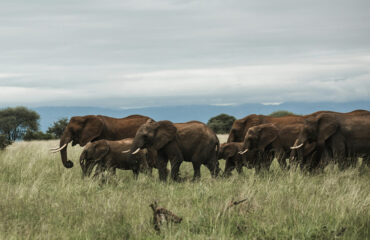
African elephants (Loxodonta africana) move through the Serengeti in family groups, feeding across the woodland margins of the western corridor, the riverine forest of the Seronera Valley, and the open savannah of the central plains. The Serengeti’s elephant population — while not as large as those of parks specifically known for elephant concentration such as Amboseli or Tarangire — provides consistently excellent and often extended elephant encounters, particularly in the western corridor and central woodland areas where family groups feed in the relative shade of the acacia canopy.
Hippopotamus & Nile Crocodile
The hippopotamus (Hippopotamus amphibius) and the Nile crocodile (Crocodylus niloticus) are the dominant large animals of the Serengeti’s river systems — and both are encountered in extraordinary numbers and at extraordinary close range during the migration river crossings.
The Seronera River pools hold permanent hippo populations that are viewable year-round — their territorial disputes, social interactions, and the endlessly surprising sound of a hippo yawn at close range providing wildlife entertainment of considerable quality even outside the crossing season. The Grumeti River holds some of the largest Nile crocodiles in Tanzania — individuals whose size (some exceeding five metres) and evident age give them an almost geological quality of ancient permanence that is both impressive and slightly unnerving to observe from the vehicle.
The Serengeti’s Buffalo Herds
Cape buffalo (Syncerus caffer) move through the Serengeti in herds that can number in the hundreds — enormous, dense aggregations of large, unpredictable animals whose collective confidence in the face of even lion aggression makes them one of the savannah’s most formidable social forces. The interaction between Serengeti buffalo herds and lion prides — in which the roles of predator and prey can reverse dramatically when a herd rallies to defend an attacked individual — is one of the most dramatic ongoing wildlife narratives in the park.
Birdwatching in the Serengeti: Over 500 Species
With over 500 recorded bird species, the Serengeti National Park is one of Tanzania’s most important and most rewarding birding destinations — a fact that is sometimes overlooked in the emphasis on the mammal wildlife, but that adds an extraordinary dimension of interest to every game drive for observers of any level of ornithological experience.
The open grassland supports spectacular large birds: the kori bustard — Africa’s heaviest flying bird, weighing up to 19 kilograms — stalks the short-grass plains with prehistoric gravity. The secretary bird hunts snakes and lizards in the long grass with characteristic stamping kicks that are both effective and extraordinarily entertaining to observe. The grey crowned crane — Tanzania’s national bird — moves in pairs and family groups across the savannah, its golden crown plume catching the light in brief brilliant flashes. Ostriches stride across the open plains in pairs and small groups, their extraordinary speed (up to 70 kilometres per hour) occasionally demonstrated when disturbed.
The kopjes support their own distinctive bird community: Verreaux’s eagle, augur buzzard, klipspringer — not a bird, but an antelope that occupies the same rocky habitat — and the extraordinary lammergeier (bearded vulture) that soars above the highest kopjes in spectacular long-winged display. The riverine forest holds African fish eagle, giant kingfisher, malachite kingfisher, pied kingfisher, African grey hornbill, silvery-cheeked hornbill, Narina trogon, and numerous sunbird, weaver, and warbler species.
The migration season adds a further dimension of avian spectacle — the concentrations of vultures above crossing points and kills are among the most visually impressive bird gatherings in Africa, with white-backed, Rüppell’s, hooded, lappet-faced, and white-headed vultures all present and the dynamics of vulture feeding hierarchies providing a compelling behavioural study in their own right.
The Serengeti Hot Air Balloon Safari
The Serengeti hot air balloon safari is one of East Africa’s most iconic and most sought-after experiences — a pre-dawn ascent above the plains that offers a perspective on the ecosystem available in no other way and creates memories of extraordinary beauty and emotional resonance.
The balloon launches in darkness — the envelope glowing against the night sky as the gas heater inflates it, a small sun of orange and gold light in the pre-dawn blackness. As the basket lifts clear of the ground and the roar of the burner settles into silence between heating cycles, the Serengeti spreads below in the slowly brightening grey of the African pre-dawn: the plains extending to every horizon, the kopjes rising as dark shapes from the flatness, the Seronera River a darker line through the landscape, and in every direction, wildlife moving in its morning patterns.
The flight typically lasts 60 to 90 minutes, drifting with the wind at altitudes between 50 and 300 metres — low enough to observe individual animals clearly, high enough to comprehend the scale of the landscape and the herds within it. A million wildebeest viewed from 200 metres altitude is a different experience from a million wildebeest viewed from the ground — the scale becomes comprehensible in a way that ground-level observation cannot provide, and the silence of the balloon flight (broken only by the periodic roar of the burner) creates a quality of presence and attention that is profoundly different from the game drive experience.
Landing is wherever the wind dictates — typically in open grassland, where the ground crew awaits with the balloon’s support vehicle and the famous champagne bush breakfast: tables laid in the field, silver service, fresh fruit and hot food, cold champagne, and the morning’s memories still fresh and vivid as the sun climbs above the Serengeti horizon. It is among the most civilised and most perfectly situated meals in Africa.
The balloon safari is available year-round from the central Serengeti and is strongly recommended as an enhancement to any Serengeti itinerary of three nights or more.
Serengeti Accommodation: From Comfortable to Extraordinary
The Serengeti’s accommodation landscape has evolved dramatically over the past two decades — from a relatively limited selection of standard lodges to one of the most diverse and most impressive collections of safari accommodation in Africa, ranging from excellent midrange tented camps to some of the most acclaimed luxury properties on the continent.
Midrange
Kubu Kubu Tented Lodge — In the central Serengeti near Seronera, Kubu Kubu offers comfortable, well-appointed tented accommodation with excellent wildlife access and a strong guiding programme. An ideal base for central Serengeti game drives and balloon safaris.
Serengeti Serena Safari Lodge — A well-established lodge in the central Serengeti’s Nyaruboru area, offering panoramic views over the surrounding plains and reliable access to the central corridor’s wildlife.
Maramboi Tented Lodge — On the edge of the Serengeti ecosystem near Lake Manyara, Maramboi provides an excellent value option for travellers combining the Serengeti with the northern Tanzania circuit.
Midrange Serengeti safari from USD 1,400 per person for 3 nights, including accommodation, guiding, park fees, and transfers.
Luxury
Four Seasons Safari Lodge Serengeti — A landmark luxury property in the central Serengeti, the Four Seasons combines exceptional accommodation standards with outstanding wildlife access, a remarkable swimming pool with wildlife viewable from the deck, and the service quality of one of the world’s most respected hotel brands.
Melia Serengeti Lodge — Perched on a kopje in the central Serengeti with panoramic views across the surrounding plains, Melia Serengeti offers architecturally extraordinary accommodation, exceptional food, and some of the finest sunset views in the park.
&Beyond Klein’s Camp — In a private concession on the northeastern edge of the Serengeti adjoining the Masai Mara, Klein’s Camp offers exclusive access, exceptional guiding, and the extraordinary combination of Serengeti wildlife and Mara River proximity in a single property.
Singita Grumeti — On the Grumeti River in the western corridor, Singita’s Grumeti properties represent the absolute pinnacle of Serengeti luxury accommodation — exclusive, beautifully designed, with exceptional food, extraordinary guiding, and the most productive western corridor wildlife access available.
Sanctuary Kichakani Serengeti Camp — A mobile camp that moves seasonally to follow the migration, Kichakani offers the ultimate migration-following experience: waking up each morning in the location where the action is currently most intense, with a camp that has relocated to be there.
Luxury Serengeti safari from USD 3,800 per person for 3 nights, including accommodation, private guiding, park fees, transfers, and balloon safari.
When to Visit the Serengeti
The Serengeti rewards visitors in every month of the year — but matching your travel timing to your specific wildlife priorities dramatically enhances the quality of the experience.
| Month | Migration Location | Key Experience | Visitor Levels |
|---|---|---|---|
| January | Southern plains/Ndutu | Calving season begins | Moderate |
| February | Southern plains/Ndutu | Peak calving season | High |
| March | Southern plains, northward movement | Late calving, predator intensity | Moderate |
| April | Central Serengeti | Long rains, green landscape | Low |
| May | Central/Western corridor | Grumeti area, lush scenery | Low |
| June | Western corridor/Grumeti | Grumeti crossings begin | Moderate |
| July | Central to Northern | Northern migration, first Mara crossings | High |
| August | Northern Serengeti | Peak Mara River crossings | Very High |
| September | Northern Serengeti/Mara | Mara crossings continue | Very High |
| October | Northern, return south | Late crossings, return movement | High |
| November | Central, southward | Short rains, herds dispersing south | Moderate |
| December | Southern plains | Herds arriving on southern plains | Moderate |
Getting to the Serengeti
By Air (Strongly Recommended): Daily scheduled flights operate from Arusha Airport and Kilimanjaro International Airport to multiple Serengeti airstrips including Seronera, Grumeti, Kogatende (northern Serengeti), Ndutu, and Lobo. Flight times range from 45 minutes (Arusha to Seronera) to approximately 90 minutes (Arusha to Kogatende). Flying between airstrips within the Serengeti is also available and strongly recommended for itineraries covering multiple sectors.
By Road: The drive from Arusha to the Serengeti takes approximately 7–8 hours via the Ngorongoro Conservation Area — a spectacular road journey across the crater highlands with a stop at the Ngorongoro rim. The road is good tarmac to the crater area and reasonable graded track within the Conservation Area. Road transfer is most appropriate for itineraries combining the Serengeti with Ngorongoro Crater and Tarangire as part of a complete northern circuit.
Planning Your Serengeti Safari with Ntungo Wildlife Safaris
The Serengeti is a destination that rewards expertise — the difference between a good Serengeti safari and an extraordinary one lies almost entirely in the quality of the guiding, the knowledge of the ecosystem’s seasonal dynamics, and the choice of accommodation relative to the migration’s current position. These are precisely the elements that Ntungo Wildlife Safaris brings to every Serengeti itinerary we design.
We have guided extensively throughout the Serengeti’s different sectors and seasons. We know which camps offer the best central access in the calving season, which northern sector properties position guests optimally for Mara River crossings, and which western corridor lodges provide the most exclusive and most productive Grumeti experience. We understand the migration’s rhythms well enough to build itineraries that maximise the probability of witnessing the specific spectacle you have travelled to see — whether that is the calving season’s extraordinary predator intensity, the river crossing drama, or the vast assembled herds of the central plains.
We also know that the Serengeti is more than its migration. We build itineraries that allow time for the kopje leopards, the morning cheetah hunts, the hippo pool observations, and the balloon flight — because the Serengeti’s full richness is revealed only to those who spend enough time inside it to look beyond the headline spectacle.
The land runs on forever. Come and find your place inside it.
Contact Ntungo Wildlife Safaris to begin planning your Serengeti safari — standalone, combined with Ngorongoro Crater and Tarangire on the northern circuit, or extended with a Zanzibar beach holiday. We offer itineraries across all accommodation tiers with private guiding, expert seasonal knowledge, and seamless logistics from arrival in Arusha to departure.
📩 info@ntungosafaris.com 🌐 www.ntungosafaris.com 📞 +256 771 399299 / +256 706 772990
Peak season accommodation in the Serengeti — particularly the northern sector during the Mara River crossing period of August to October — books up 6 to 12 months in advance. Early reservation is strongly recommended.