Lake Nakuru National Park: The Jewel of Kenya’s Rift Valley
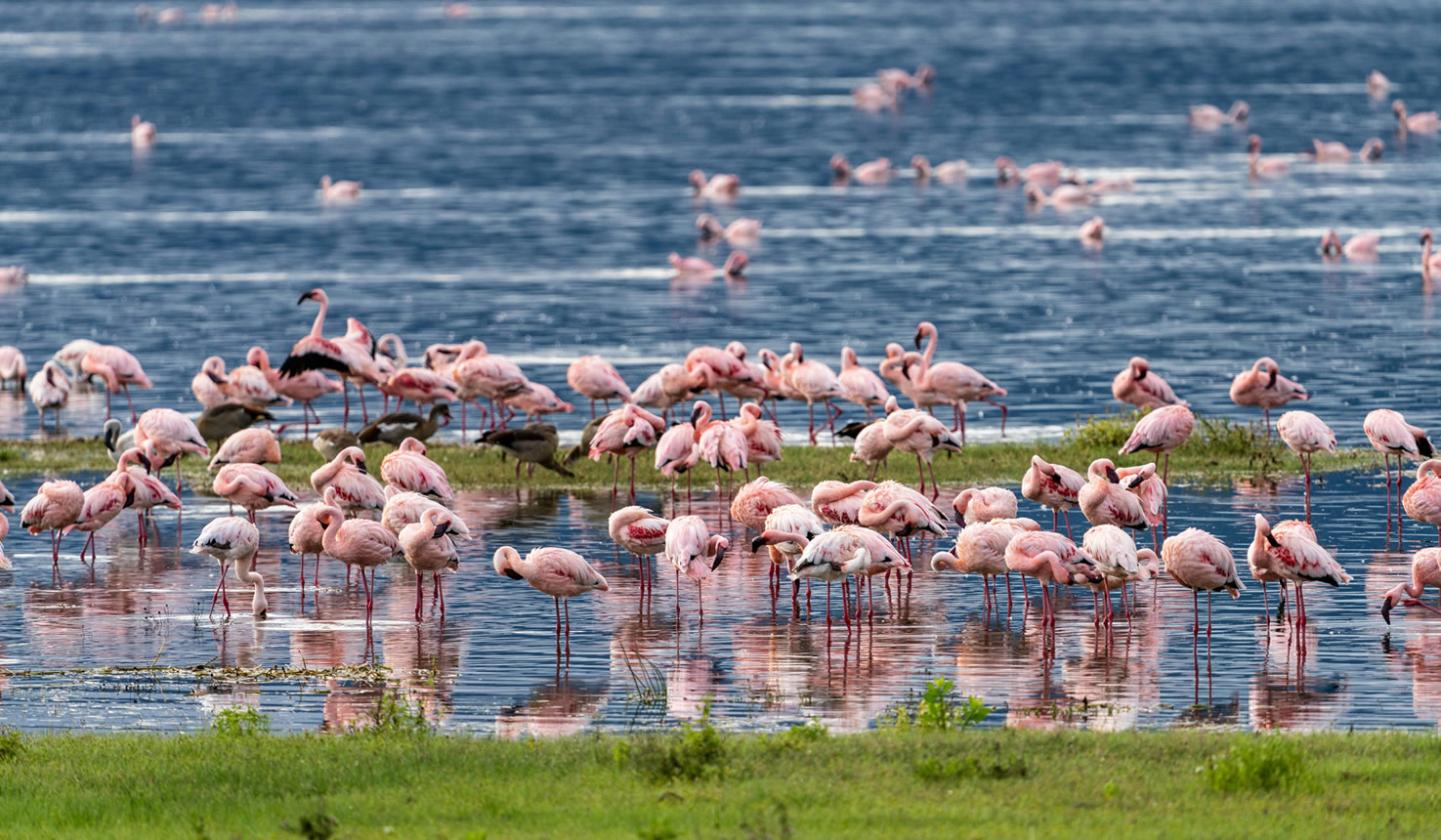
There is a moment at Lake Nakuru that stops even the most seasoned safari traveller in their tracks. You are standing on the raised viewpoint above the lake’s southern shore — the water spread below you in a wide, shallow, alkaline expanse — and the entire shoreline is pink. Not partially pink. Not pink in patches. Pink from one end of the visible horizon to the other, a solid, continuous, living band of colour that shifts and ripples and occasionally lifts in great rosy clouds as something disturbs the flock.
You are looking at flamingos. Hundreds of thousands of them. Perhaps more than a million. Standing in water so shallow their legs are visible to the knee, their heads down in constant feeding motion, their extraordinary rose-pink plumage reflecting in the lake’s alkaline surface to create a doubling of the spectacle that makes the whole scene feel, for a moment, almost implausibly beautiful.
This is Lake Nakuru at its most iconic — and it is one of the natural world’s great visual experiences.
But Lake Nakuru is considerably more than its flamingos. Lake Nakuru National Park — a compact, fenced, remarkably productive wildlife sanctuary encircling the lake in Kenya’s Great Rift Valley — is one of the most diverse and most accessible wildlife destinations in East Africa. Within its 188 square kilometres, the park supports the Big Five, a remarkable rhino sanctuary protecting both black and white rhinoceros, large populations of lions and leopards, Rothschild’s giraffes introduced to protect a globally endangered subspecies, and over 450 recorded bird species that make it one of Kenya’s premier birding destinations.
The park sits just 160 kilometres northwest of Nairobi — a comfortable 2-hour drive on good tarmac — making it one of the most accessible major wildlife destinations in Kenya and an ideal destination for travellers with limited time, for those combining Nakuru with the Masai Mara or Amboseli, or for anyone seeking an exceptionally rewarding wildlife experience within easy reach of the capital.
A Lake Nakuru safari with Ntungo Wildlife Safaris delivers the full breadth of this extraordinary park — the flamingo spectacle, the rhino sanctuary, the predator-rich forest and grassland, and the stunning Rift Valley scenery — in a seamlessly guided experience that makes the most of every hour in the field.
The Lake: An Alkaline Marvel of the Rift Valley
Lake Nakuru is a shallow, saline-alkaline lake occupying the floor of the Great Rift Valley at an elevation of approximately 1,754 metres above sea level. It is one of a chain of soda lakes running along the Rift Valley floor through Kenya and Tanzania — including Lakes Bogoria, Elementaita, Magadi, and Natron — whose alkaline chemistry, driven by volcanic minerals leaching into the water from the surrounding geology, creates conditions hostile to most forms of aquatic life but extraordinarily productive for the blue-green algae (Arthrospira fusiformis) that grows in vast quantities in the warm, shallow, highly alkaline water.
This algae is the foundation of everything. It is the primary food source for the lesser flamingo (Phoeniconaias minor) — the smaller and more numerous of Africa’s two flamingo species — which filters it from the water using a uniquely designed bill that operates as a specialised pump, drawing water through fine lamellae that trap the algae while expelling the water. A single lesser flamingo consumes approximately 60 grams of algae per day; a flock of a million flamingos processes an extraordinary quantity of biological material from the lake’s surface, making the flamingo population one of the most ecologically significant forces in the Rift Valley’s aquatic ecosystem.
The greater flamingo (Phoenicopterus roseus) — larger, paler, and less numerous — feeds alongside the lesser in the shallower margins, its diet including invertebrates and organic matter in addition to algae. The two species are distinguishable at even moderate distance: the lesser is a deeper, more saturated pink, while the greater is predominantly white with pink wing highlights and a distinctive pink-and-black bill.
The lake’s flamingo population fluctuates significantly over time — driven by changes in water level, algal productivity, and the birds’ own movement patterns between the Rift Valley’s soda lakes. At its peak, Lake Nakuru has hosted over 2 million lesser flamingos simultaneously — the largest flamingo gathering ever recorded anywhere in the world, a spectacle of such biological abundance that it was described by Sir David Attenborough as “one of the world’s greatest wildlife sights.” Numbers today are typically lower than historical peaks — partly due to rising water levels that have diluted the lake’s alkalinity and reduced algal growth — but concentrations of several hundred thousand flamingos remain common, and the spectacle they create is extraordinary by any standard.
Recent years have seen the lake’s water level fluctuate significantly — at times rising to flood previously dry areas of the surrounding woodland, at others receding to concentrate the remaining water and its dependent wildlife in smaller areas. These fluctuations are natural features of Rift Valley lake systems and are accommodated by the wildlife that depends on them, with flamingo populations moving fluidly between Nakuru and the other soda lakes of the system as conditions change.
The Rhino Sanctuary: Kenya’s Most Important Conservation Achievement
If the flamingos are Lake Nakuru’s most visually spectacular residents, the rhinoceros — both species, both present, both actively protected — represents its most profound conservation significance.
Lake Nakuru National Park is one of Kenya’s most important rhino sanctuaries, and a visit here to encounter these extraordinary animals is not simply a wildlife experience. It is an encounter with one of conservation’s most hard-fought and most meaningful ongoing battles — and a reminder, in the most direct and personal way possible, of what we stand to lose and what sustained, determined effort can protect.
Black Rhinoceros
The black rhinoceros (Diceros bicornis) is one of the world’s most critically endangered large mammals. At the height of the poaching crisis in the 1970s and 1980s, the global black rhino population collapsed from an estimated 70,000 individuals to fewer than 2,500 — a decline of over 96% in two decades, driven entirely by poaching for the international horn trade. Kenya’s black rhino population was almost completely eliminated during this period, and the animals that survived did so largely in protected sanctuaries like Lake Nakuru, where anti-poaching enforcement and physical fencing provided a degree of protection unavailable in open landscapes.
Today, Lake Nakuru National Park’s black rhino population — carefully managed, individually monitored, and protected by dedicated ranger teams — is one of the most important in East Africa. The park’s fenced boundary, while a compromise from a purist conservation perspective, has been essential to the black rhino’s survival in this landscape, and the population here contributes significantly to Kenya’s gradual national recovery.
Encountering a black rhinoceros at Lake Nakuru — typically in the park’s more forested western and southern sectors, where the dense acacia and euphorbia woodland provides the cover this species prefers — is an experience of genuine rarity and weight. The black rhino is smaller and more agile than its white cousin, with a distinctive prehensile upper lip adapted for browsing leaves and twigs from woody vegetation rather than grazing grass. It is famously more solitary and more temperamental, and the experience of finding one moving through dense bush — the prehistoric bulk of it, the extraordinary horn, the sudden awareness of being in the presence of an animal that has existed almost unchanged for millions of years but now exists in such desperately reduced numbers — is deeply moving.
White Rhinoceros
The white rhinoceros (Ceratotherium simum) is the larger of the two species — the second-largest land animal in Africa after the elephant, with adult males weighing up to 2,300 kilograms — and a conservation success story of remarkable proportions. The southern white rhinoceros (C. s. simum), once reduced to fewer than 50 individuals at the end of the 19th century, has recovered to a global population of approximately 18,000 through one of the most successful large mammal conservation programmes in history — though the species remains threatened by continuing poaching pressure.
Lake Nakuru’s white rhinoceros population — introduced from South Africa as part of a deliberate restocking programme — grazes the park’s open grassland areas in family groups and as solitary adult males, and is considerably easier to observe than the black rhinoceros. White rhinos are grazers, preferring short grassland habitat, and they are typically found in the park’s northern and eastern sectors where open grassland is most extensive. Their enormous size, squared-off lips adapted for cropping grass, and relatively placid temperament make close observation in open terrain both possible and extraordinary — a white rhino family grazing in the morning light, their great grey forms moving with surprising grace across the short-grass plains, is one of Lake Nakuru’s most magnificent and most photographic wildlife encounters.
Having both rhino species in the same park — available to observe on a single game drive — is a rare privilege that only a handful of destinations in Africa can offer. Lake Nakuru is one of them.
Lions & Leopards: Nakuru’s Predator Story
The introduction of a security fence around Lake Nakuru National Park in the 1980s and 1990s — primarily to protect the rhino population from poaching — had an unexpected and far-reaching effect on the park’s broader ecology: it created a contained, self-sustaining predator-prey system that has produced some of the most reliable and most spectacular predator encounters in Kenya.
Lions
Lake Nakuru’s lion population — resident within the fenced park boundary — has access to a prey base of extraordinary abundance: the park’s large populations of buffalo, waterbuck, zebra, warthog, and impala support a significant lion population that is consistently and reliably encountered on game drives throughout the park.
The park’s varied terrain — open grassland in the north and east, dense euphorbia and acacia woodland in the west and south, rocky escarpments along the park’s elevated margins — creates a diversity of lion habitat that supports multiple pride territories with different hunting strategies and behavioural patterns. Lions in the open grassland areas are easily spotted in classic savannah fashion, particularly in the early morning when they are still active from the night’s hunting. Lions in the woodland and escarpment areas are more cryptic but reward patient searching, particularly along rocky ridgelines where prides rest in the shade during the hottest hours of the day.
The contained nature of the park means that lion densities are relatively high and encounters are among the most reliable in Kenya — a significant advantage for visitors with limited time who want to maximise the quality and frequency of predator sightings.
Leopards
Lake Nakuru is one of Kenya’s finest destinations for leopard encounters — a fact less widely publicised than the flamingos and rhinos but well-known among experienced Kenya safari guides. The park’s dense woodland and rocky escarpment habitat is ideal leopard territory, and the relatively small size of the park combined with a concentrated, well-monitored leopard population makes sightings more predictable than in larger, more open wildlife areas.
Leopards in Lake Nakuru are most frequently encountered in the Makalia and Nderit areas of the park’s southern woodland, where the combination of dense acacia cover, rocky outcrops, and proximity to the lake’s shoreline provides the full range of habitat that leopards require. Dawn and late afternoon drives in these areas — when leopards are most active and most visible — consistently produce sightings, and the park’s several well-known individual leopards, including females with cubs that have become habituated to vehicle presence, allow extended observations of natural behaviour that are among the most rewarding predator encounters in Kenya.
Rothschild’s Giraffe: A Conservation Introduction
Among Lake Nakuru’s most remarkable wildlife stories is the presence of a population of Rothschild’s giraffe (Giraffa camelopardalis rothschildi) — one of the world’s most endangered giraffe subspecies, with fewer than 2,000 individuals remaining in the wild.
Rothschild’s giraffe is distinguished from the more common Maasai giraffe by its paler, more defined coat pattern, its lack of markings below the knee (giving the appearance of wearing white stockings), and by the presence of five ossicones (horn-like protrusions on the head) rather than the usual two. It is a larger subspecies than the Maasai giraffe, and its extraordinarily distinctive appearance makes it immediately recognisable in the field.
The Rothschild’s giraffe population at Lake Nakuru was introduced as part of a deliberate conservation translocation from populations in Uganda — a programme designed to establish a self-sustaining population in a protected Kenyan environment and reduce the vulnerability of a subspecies whose wild numbers had declined to critically low levels. The Nakuru population has grown steadily since introduction and is now a significant component of the park’s conservation mandate — as well as being one of the most visually striking and most photographed wildlife encounters in the park.
Observing Rothschild’s giraffe browsing the acacia canopy in the park’s woodland areas, their extraordinary height allowing access to browse unavailable to any other herbivore, is a wildlife encounter made all the more meaningful by the knowledge of how close this subspecies came to extinction — and how directly the presence of these animals at Nakuru reflects a deliberate and successful conservation intervention.
Birdwatching at Lake Nakuru: A Rift Valley Avian Paradise
With over 450 recorded bird species, Lake Nakuru National Park is one of Kenya’s finest and most rewarding birding destinations — combining the extraordinary spectacle of the flamingo flocks with a remarkable diversity of woodland, grassland, wetland, and cliff-nesting species that make systematic birding in the park an endlessly productive and satisfying experience.
The Flamingos
The lesser and greater flamingos are the park’s most celebrated avian residents, and their extraordinary concentrations on the lake’s alkaline margins are the single most visually spectacular birding experience available anywhere in the Rift Valley. Even for non-birders, the sheer scale of the flamingo gathering — the colour, the movement, the extraordinary collective behaviour of a flock of hundreds of thousands of birds operating as a single fluid organism — is an experience of profound natural wonder.
Pelicans & Waterbirds
The lake and its immediate margins support an exceptional diversity of waterbirds beyond the flamingos. The great white pelican (Pelecanus onocrotalus) is a permanent resident, with large breeding colonies on the lake’s islands producing some of Africa’s most spectacular colonial nesting scenes — hundreds of enormous birds occupying the same small island in a chaos of nest-building, courtship displays, and chick-rearing that is extraordinary to observe at close range from a boat or shoreline viewpoint.
African spoonbills, yellow-billed storks, African openbill storks, marabou storks — their extraordinary bare-skinned heads and pendulous throat pouches giving them an appearance of somewhat lugubrious grandeur — grey herons, goliath herons, black-headed herons, purple herons, little egrets, great white egrets, intermediate egrets, African sacred ibis, hadada ibis, and glossy ibis all inhabit the lake’s margins in significant numbers. The African jacana walks across lily pads on its extraordinary elongated toes. African pygmy geese, knob-billed ducks, spur-winged geese, and Egyptian geese occupy the open water and marshy margins.
Raptors
Lake Nakuru’s varied terrain produces excellent raptor diversity. The African fish eagle — whose call is the definitive sound of African wilderness — is present and vocal throughout the park. The augur buzzard, African hawk-eagle, long-crested eagle, Wahlberg’s eagle, and martial eagle are all recorded regularly. The park’s escarpment cliffs support nesting Verreaux’s eagle (Aquila verreauxii) — one of Africa’s most magnificent raptors, an enormous black eagle that feeds almost exclusively on rock hyrax and soars above the cliffs with a mastery of the air that is extraordinary to observe.
The Verreaux’s eagle owl — Africa’s largest owl, with conspicuous pink eyelids that give it a surprisingly distinguished appearance — is resident in the park’s woodland areas and regularly encountered on night drives or at roost sites in the early morning.
Forest & Woodland Birds
The park’s extensive acacia and euphorbia woodland supports a rich community of forest and woodland birds. The African green pigeon, Ross’s turaco, Hartlaub’s turaco, black-and-white casqued hornbill, African grey hornbill, crowned hornbill, and Silvery-cheeked hornbill are all present in the woodland canopy. The green woodhoopoe moves through the acacia in noisy, clattering family parties. The African broadbill, African paradise flycatcher, and African blue flycatcher inhabit the denser woodland sections. A remarkable diversity of sunbirds — variable sunbird, bronze sunbird, Marico sunbird, beautiful sunbird, scarlet-chested sunbird — feed at flowering trees throughout the park, their metallic plumage catching the light in brief, brilliant flashes.
Flamingo Photography Tips
For photographers visiting specifically for the flamingo spectacle:
Dawn and dusk are the optimal times — the low-angle light transforms the flamingo pink into something extraordinary, and the still morning air means the lake surface acts as a perfect mirror, doubling the visual impact of the flock. The southern and eastern shoreline viewpoints provide the best unobstructed views across the lake to the flamingo concentrations. A telephoto lens of at least 400mm is recommended for tight flamingo portraits; a wider lens captures the full scale of the spectacle. Patience is rewarded — the flocks move, lift, and resettle continuously, and the moments when a disturbance sends thousands of birds airborne simultaneously produce images of breathtaking drama.
The Escarpment & Scenic Viewpoints
Lake Nakuru National Park is not only a wildlife destination — it is a landscape of considerable scenic grandeur, and several viewpoints within the park offer panoramic perspectives on the lake and surrounding terrain that are memorable in their own right.
Baboon Cliff — in the park’s northern sector — provides one of the finest aerial views of the entire lake, the alkaline water spread below and the pink band of flamingos visible along the far shoreline on productive days. The cliff is home to large troops of olive baboons whose social dynamics — grooming sessions, dominance disputes, the chaos of juvenile play — are endlessly entertaining to observe at close range.
Lion Hill — in the park’s northeastern corner — is both a reliable vantage point for lake views and, as its name suggests, a productive area for lion sightings in the surrounding grassland and woodland.
Makalia Falls — in the park’s southern sector — is a beautiful waterfall where the Makalia River tumbles over the escarpment into the wooded valley below, creating a permanently moist and productive microhabitat for forest birds, butterflies, and the various small mammals that inhabit the riparian vegetation.
The Rift Valley escarpment that forms the park’s eastern boundary — visible on clear days as a dramatic wall of rock and forest rising steeply from the valley floor — provides the geological context for the lake and its ecosystem: a reminder that Lake Nakuru sits in one of the earth’s great geological features, a rift in the continental crust that has been forming for over 20 million years and that has shaped the ecology, geography, and human history of East Africa more profoundly than any other single geological phenomenon.
Combining Lake Nakuru with Other Kenya Destinations
Lake Nakuru’s location — 160 kilometres northwest of Nairobi on the main highway toward Kisumu — makes it one of the most easily combined destinations in Kenya’s wildlife circuit.
Lake Nakuru + Masai Mara: The classic Kenya northern circuit combination, connecting the Rift Valley soda lake spectacle and rhino sanctuary with the open savannah of the Mara and the Great Migration. Typically 2 nights at Nakuru followed by 3–4 nights in the Mara, or in reverse. Accessible by road (via the B3 highway through Narok) or by a combination of road transfer to Nakuru and light aircraft to the Mara.
Lake Nakuru + Amboseli: A compelling combination connecting the Rift Valley flamingo and rhino experience with Amboseli’s extraordinary elephant population and Kilimanjaro views. Typically connected via Nairobi with a road or air transfer between the two destinations.
Lake Nakuru + Lake Naivasha: Lake Naivasha — a freshwater lake approximately 40 kilometres south of Nakuru — is one of Kenya’s most beautiful and most productive birding destinations, home to enormous concentrations of waterbirds, a significant hippo population, and the famous Crescent Island wildlife sanctuary. A combined Nakuru and Naivasha itinerary of 2–3 days provides an outstanding Rift Valley lakes experience and pairs exceptionally well with a Masai Mara safari as a complete Kenya journey.
Lake Nakuru + Lake Bogoria: Lake Bogoria — 50 kilometres north of Nakuru — is another Rift Valley soda lake, famous as one of the most reliable alternative sites for lesser flamingo concentrations when water levels at Nakuru are unfavourable, and for its extraordinary geysers and hot springs that erupt along the lake’s western shoreline in a spectacle of steaming, bubbling thermal activity that is entirely unique in East African wildlife travel.
Practical Information
Getting There:
By Road: Lake Nakuru National Park is approximately 160 kilometres from Nairobi via the A104 highway — a comfortable 2-hour drive on good tarmac. The park’s main Lanet Gate is situated on the park’s northern boundary near Nakuru town. A 4WD vehicle is recommended for game drives within the park, particularly in the wet season when some tracks become challenging.
By Air: Nakuru Airport receives occasional charter and scheduled light aircraft flights from Nairobi Wilson Airport. For most visitors, however, road transfer from Nairobi is the most convenient and most cost-effective option given the short distance and good road conditions.
Park Entry Fees: Lake Nakuru National Park charges a daily conservation fee for all visitors. Current fees are available from Kenya Wildlife Service (kws.go.ke). Fees are included in all Ntungo Wildlife Safaris packages.
Best Time to Visit: Lake Nakuru can be visited year-round. Flamingo concentrations fluctuate with the lake’s water level and alkalinity — dry season periods (June–September and January–February) typically produce the most concentrated flamingo gatherings. Rhino, lion, and leopard sightings are excellent year-round. The wet season (March–May and October–November) produces lush green landscapes and excellent birdlife but some tracks within the park may be challenging.
Duration: A minimum of 1 full day (2 nights) allows comprehensive coverage of the park’s key areas and wildlife. 2 full days (3 nights) allows more relaxed game driving and greater flexibility to wait for specific wildlife encounters — particularly recommended for birders and photographers.
Accommodation: Lake Nakuru’s accommodation ranges from comfortable midrange lodges and tented camps within and adjacent to the park to luxury properties with extraordinary views over the lake and escarpment.
Midrange: Lake Nakuru Lodge, Sarova Lion Hill Game Lodge, Flamingo Hill Tented Camp Luxury: Mbweha Camp, Sopa Lodge Nakuru, Lake Nakuru Sopa Lodge
Wildlife Summary: What to Expect at Lake Nakuru
| Species | Presence | Best Viewing Area |
|---|---|---|
| Lesser flamingo | Year-round (variable) | Lake shoreline, all sectors |
| Greater flamingo | Year-round | Lake shoreline, northern margins |
| White rhinoceros | Year-round | Northern & eastern grassland |
| Black rhinoceros | Year-round | Western & southern woodland |
| Lion | Year-round | Kasenyi plains & escarpment |
| Leopard | Year-round | Southern woodland & escarpment |
| Rothschild’s giraffe | Year-round | Woodland areas, all sectors |
| Cape buffalo | Year-round | Open grassland & woodland |
| Waterbuck | Year-round | Lakeshore & grassland margins |
| Olive baboon | Year-round | Baboon Cliff & woodland |
| African fish eagle | Year-round | Lake margins & woodland |
| Great white pelican | Year-round | Lake islands & open water |
| Verreaux’s eagle | Year-round | Eastern escarpment cliffs |
| Marabou stork | Year-round | Lakeshore & woodland |
Why Lake Nakuru Belongs on Every Kenya Safari
In a country of extraordinary wildlife destinations, Lake Nakuru National Park occupies a unique position — compact enough to be thoroughly explored in two days, accessible enough to fit into almost any Kenya itinerary, and rich enough in wildlife diversity and scenic beauty to stand comfortably alongside Kenya’s most celebrated parks as a destination of genuine world-class significance.
The flamingo spectacle is unlike anything else in East Africa. The rhino sanctuary is one of the continent’s most important conservation achievements. The predator encounters — both lion and leopard — are among the most reliable in Kenya. The birdlife is extraordinary. And the setting — a shimmering alkaline lake on the floor of the Great Rift Valley, framed by escarpment walls and ancient acacia woodland — is one of the most beautiful in the entire region.
Lake Nakuru is not a compromise destination for travellers who cannot make it to the Masai Mara. It is a complete, self-contained, and deeply rewarding wildlife experience in its own right — one that every visitor to Kenya deserves to include in their itinerary.
The flamingos are waiting. The rhinos are grazing. And the lake is pink.
Contact Ntungo Wildlife Safaris to incorporate Lake Nakuru National Park into your Kenya safari itinerary. We offer standalone Nakuru packages, combined Rift Valley lakes itineraries, and full Kenya northern circuit programmes connecting Nakuru with the Masai Mara, Amboseli, Samburu, and the Kenya coast.
📩 info@ntungosafaris.com 🌐 www.ntungosafaris.com 📞 +256 771 399299 / +256 706 772990
Peak season accommodation in the Masai Mara sells out 6–12 months in advance. Early booking is strongly recommended for travel between July and October.