Masai Mara Safari: Where the Wild Things Are — and Always Have Been
There is a particular quality of light in the Masai Mara at dawn that does something to a person. It arrives slowly — a pale gold seeping across the horizon before the sun itself appears — and in the moments before full daylight, the entire savannah exists in a kind of suspended animation. The grass holds the dew. The acacia trees are dark silhouettes. And somewhere out there, in the blue-grey distance, a lion is finishing the night’s work while a million wildebeest are beginning the day’s journey.
You are sitting in a open-sided vehicle. Your coffee is still warm. Your guide is listening.
This is the Masai Mara — and there is nowhere else on earth quite like it.
Kenya’s most celebrated national reserve covers 1,510 square kilometres of southwestern Kenya’s Rift Valley — a vast, open, rolling grassland ecosystem that forms the northern extension of the Serengeti-Mara system, one of the last great intact wildlife areas remaining on earth. Together, the Masai Mara National Reserve and its surrounding network of private conservancies protect a landscape of extraordinary ecological richness: home to more than 95 mammal species, over 570 bird species, and the annual spectacle of the Great Wildebeest Migration — a movement of over 1.5 million animals that is, by any measure, the greatest wildlife event on the planet.
But the Masai Mara is more than a destination. It is an argument — one that wildlife, landscape, and human culture make together, in different ways on every visit — for why wild places matter and why their protection is one of the most important undertakings of our time.
A Masai Mara safari with Ntungo Wildlife Safaris puts you inside that argument. And it will change the way you think about the world.
The Landscape: Understanding What You Are Looking At
Before the wildlife, there is the land — and understanding the Masai Mara’s landscape is the first step toward understanding why it produces the wildlife encounters it does.
The reserve sits on the floor and eastern escarpment of the Great Rift Valley at an elevation of approximately 1,500 metres above sea level. This elevation gives the Mara its distinctive climate — warm by day, cool at night, with a reliable seasonal rainfall pattern that drives the vegetation cycles upon which the entire ecosystem depends. The long rains of March to May and the short rains of October to November transform the landscape from golden brown to vivid green, triggering grass growth that pulls the migration herds northward and southward across the ecosystem in their ancient, rain-following circuit.
The terrain itself is deceptively varied. The open grassland plains of the central and southern Mara — the landscape most associated with the Mara in photographs and documentaries — are in fact just one of several distinct habitat types. The Mara River and its tributary the Talek River cut through the reserve from east to west, their banks lined with dense riverine forest of fig, croton, acacia, and yellow fever tree that provides critical habitat for leopards, olive baboons, and an extraordinary concentration of forest birds. The Siria Escarpment in the reserve’s western section — a dramatic wall of rock and forest rising above the Mara Triangle — creates its own microclimate and wildlife community. The Oloololo Gate area in the northwest holds some of the Mara’s finest predator territories, while the Musiara Marsh in the north — the home of the famous Marsh Pride — is one of Africa’s most consistently productive lion viewing areas.
And beyond the national reserve boundary, the private conservancies — established on Maasai community land through conservation agreements that pay landowners directly — add a further vast area of protected habitat in which exclusive, low-density safari experiences with night drives, off-road driving, and bush walks are available to guests of the conservancy camps.
Understanding these different zones and their respective wildlife communities is what separates an expert-guided Masai Mara safari from a basic game drive. Your Ntungo guide knows where the lion prides are denning this week, which section of the Mara River the hippos are currently defending, where the cheetah coalition was seen hunting yesterday morning, and which conservancy track is most likely to produce a leopard sighting at dawn. That knowledge — accumulated through years of guiding in this specific landscape — is what the Masai Mara experience is ultimately built on.
The Great Migration: Nature’s Most Ambitious Journey
The Great Wildebeest Migration is the reason many people come to the Masai Mara — and it is, without qualification or exaggeration, the greatest wildlife spectacle on earth.
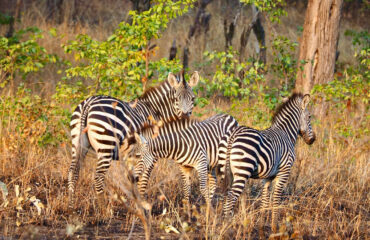
The migration is a continuous, year-round movement of approximately 1.5 million wildebeest, 400,000 zebra, and 200,000 Thomson’s gazelle around the Serengeti-Mara ecosystem — a clockwise annual circuit covering over 3,000 kilometres that is driven by a single, relentless imperative: the search for fresh grazing grass, which grows only where and when it has recently rained. The herds follow the rain with an instinct refined over millions of years of evolutionary pressure, and the result is one of the most spectacular and most ancient natural phenomena on earth — a movement of animals so vast that it shapes the entire ecology of the ecosystem it passes through.
The Masai Mara receives the migration at the dramatic northern apex of this circuit — typically between July and October — when the vast northward-moving herds encounter the obstacle that has made the migration world-famous: the Mara River.
The Mara River Crossings
The Mara River is approximately 30 to 50 metres wide at its principal crossing points — a muscular, fast-flowing, brown-watered river fringed by dense riparian forest and harbouring some of the largest Nile crocodiles in East Africa. During the dry season, when the river is at its lowest and most crossable, the migration herds press northward from Tanzania and arrive at the southern bank in their hundreds of thousands.
What happens next is not predictable, not schedulable, and not something that any description fully prepares you for.
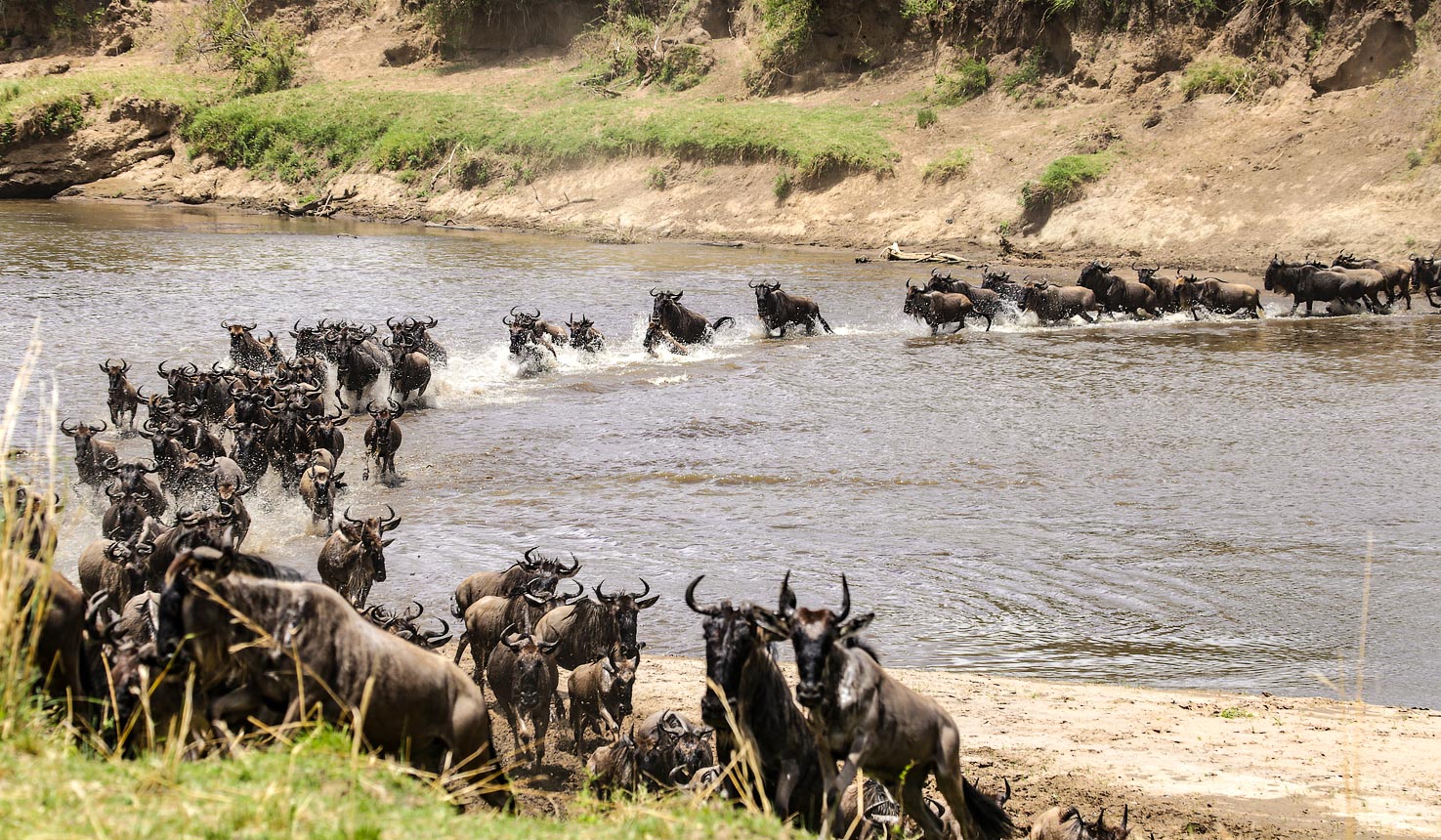
The herd masses on the bank. The animals at the front press forward under the weight of those behind, then suddenly reverse, causing a wave of panic that ripples back through the crowd. Crocodiles position themselves in the water with an intelligence that seems almost tactical — holding in the deeper channels where the crossing animals are most vulnerable. And then, with a logic that belongs entirely to the collective and not to any individual, the herd commits.
The crossing begins as a trickle and becomes, within seconds, an avalanche. Thousands of animals launch themselves off the bank simultaneously, the river churning white with their passage. Crocodiles strike from below the surface with explosive speed. Animals lose their footing on the far bank’s steep, slippery clay walls and are swept downstream. The noise — hooves on rock, the churning water, the panicked calling of separated animals — is extraordinary and continuous. And the smell, the dust, the spray, the sheer overwhelming physicality of being present at a Mara River crossing is something that no wildlife film has ever fully communicated.
Crossings can last from three minutes to three hours. A single river section may see multiple crossings in a single day during peak season, or go ten days without any crossing at all. The unpredictability is both the frustration and the glory of the experience — the wildebeest cross on their own terms, in their own time, and the role of the observer is simply to be present and ready.
Your Ntungo guide’s knowledge of the herd’s current position, the river’s recent crossing history, and the local ranger network’s real-time intelligence maximises the time spent at the most productive crossing points — giving you the best possible chance of witnessing this extraordinary spectacle in its full, unedited drama.
The Migration Beyond the Crossings
The Mara River crossings are the migration’s most dramatic single moment — but the migration’s presence in the Masai Mara transforms the entire ecosystem experience for the months it is here, not just at the river.
When the herds are in the Mara — typically July through October, though this varies with the rains — the reserve’s open grassland plains are transformed. The horizon is not empty savannah. It is wildebeest, from one edge of vision to the other, their movement and their calling creating a living landscape of extraordinary scale and energy. Predator activity increases dramatically as lions, cheetahs, leopards, hyenas, and wild dogs capitalise on the abundance. Vultures spiral above kills in their hundreds. The entire ecosystem operates at an intensity and a productivity that is qualitatively different from any other time of year.
And between crossings — during the periods when the herd is resting, grazing, or building toward the next river commitment — the behaviour of the assembled animals is itself endlessly compelling to observe: the complex social dynamics of mixed wildebeest and zebra herds, the alarm systems that ripple through a thousand animals simultaneously when a predator is spotted, the extraordinary patience of the crocodiles holding station in the river as the herd masses above them.
The Big Five in the Masai Mara
The Big Five — lion, elephant, Cape buffalo, leopard, and rhinoceros — are all present in and around the Masai Mara ecosystem, though rhino sightings require specific knowledge of the populations present in the Mara’s private conservancies and the Ol Pejeta Conservancy further north.
Lion
The Masai Mara supports one of the highest concentrations of lions (Panthera leo) of any protected area in Africa. The reserve and its adjacent conservancies are home to multiple well-documented prides, and lion sightings on the Mara are among the most reliable and most intimate in East Africa — the lions’ long habituation to safari vehicles allows an extraordinary quality of close observation that simply is not available in less visited wildlife areas.
The Marsh Pride — resident in the Musiara Marsh area and made internationally famous through decades of BBC wildlife filming — is the Mara’s most celebrated lion family, and their descendants continue to hold territory in the northern section of the reserve. Other major prides hold territories across the Mara Triangle, the Sekenani area, and the private conservancies — your guide’s up-to-date knowledge of current pride locations and dynamics is essential for maximising lion encounters.
Lion behaviour in the Mara is varied and endlessly compelling: coalition males patrolling territory boundaries with the focused intensity of animals whose social position depends on constant vigilance, prides with young cubs providing extraordinary scenes of family interaction and play, and the full drama of a Mara lion hunt — typically conducted at dawn or dusk, often targeting wildebeest or zebra, and occasionally resulting in kills visible from the vehicle at close range — is among the most powerful wildlife experiences in East Africa.
Leopard
The leopard (Panthera pardus) is the Masai Mara’s most consistently elusive big cat — and for that reason, the most satisfying to find. The Mara’s riverine forest along the Mara and Talek rivers provides ideal leopard habitat, and the reserve’s several well-known individual leopards — particularly the females with dependent cubs that use the riverine fig trees as both resting sites and cub-raising platforms — are encountered with increasing frequency by experienced guides who know their home ranges and daily patterns.
Dawn and dusk drives along the river corridors are the most productive approach — leopards are most active in the low light of morning and evening, and their eye-shine in the vehicle’s spotlight on a night drive (available in the private conservancies) dramatically increases encounter frequency. A leopard in full daylight, draped with characteristic elegance across a fig tree branch above the river, with a kill cached in the branches above it, is one of the Masai Mara’s most photographic and most coveted wildlife moments.
Cheetah
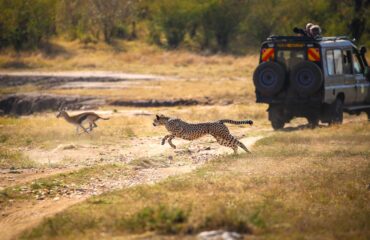
The cheetah (Acinonyx jubatus) is perhaps the Mara’s most reliably and most easily observed big cat — the open grassland terrain of the reserve’s central plains provides ideal cheetah habitat, excellent visibility for spotting them, and the full unobstructed view of a cheetah hunt that is impossible in denser bush environments.
The Mara’s several well-known cheetah coalitions — groups of two to five males that hunt cooperatively and hold shared territories across the open plains — are encountered regularly on morning game drives, particularly in the Olare Motorogi and Naboisho conservancy areas. Coalition hunting is more powerful and more frequently successful than solitary hunting, and witnessing a coalition bring down a Thomson’s gazelle in a coordinated pursuit across the open grassland — the acceleration, the teamwork, the explosive conclusion — is one of the Mara’s most electrifying wildlife encounters.
Female cheetahs with cubs are equally compelling to observe — the demands of raising cubs in a landscape full of competing predators that will kill cheetah cubs given the opportunity creates a constant, visible tension in a mother cheetah’s behaviour that is fascinating to watch over an extended observation period.
Elephant
African elephants (Loxodonta africana) move through the Masai Mara in family groups, feeding across the woodland margins, open grassland, and riverine forest with the measured, purposeful dignity of animals that have inhabited this landscape for hundreds of thousands of years. The Mara’s elephant population is not as large as those of parks like Amboseli or Tsavo, but encounters with family groups — particularly at the Mara River margins where elephants drink and occasionally swim — are consistently excellent and often extended.
The interaction between elephants and the migration herds is one of the Mara’s more unexpected wildlife dynamics — elephants moving calmly through wildebeest aggregations of thousands of animals, the herds parting to allow passage and closing again behind, a demonstration of the complex social signalling between species that characterises a mature, intact ecosystem.
Buffalo
Cape buffalo (Syncerus caffer) are among the Masai Mara’s most abundant large mammals — enormous bachelor herds and mixed breeding herds move across the grassland plains in aggregations that can number in the hundreds, and their interactions with the Mara’s lion prides are some of the most dramatic predator-prey encounters in the reserve. A buffalo herd that turns on pursuing lions — the roles of predator and prey suddenly, violently reversed — is one of the African savannah’s most extraordinary wildlife reversals, and it is not uncommon in the Mara where buffalo herds are large enough and bold enough to mount effective collective defence.
The Masai Mara Private Conservancies
For many experienced safari travellers, the private conservancies adjoining the Masai Mara National Reserve represent the finest safari experience in Kenya — combining the wildlife richness of the broader Mara ecosystem with the exclusivity, intimacy, and experiential depth that the national reserve itself cannot fully provide.
The conservancies were established through agreements between Maasai landowners, conservation organisations, and safari operators that provide direct, meaningful financial payments to landowners in exchange for wildlife-friendly land use. The model is one of conservation’s most successful examples of aligning community economic interests with wildlife protection, and the results — both for wildlife and for the quality of safari experience — are extraordinary.
Within the conservancies, guests of the resident camps benefit from:
Night game drives — conducted after dark with spotlights, revealing the nocturnal world of leopards, servals, civets, genets, honey badgers, porcupines, and the various owl species that make the Mara night a rich and completely different wildlife environment from the day.
Off-road driving — the ability to leave the established tracks and follow wildlife across open terrain, allowing precise positioning for photography and sustained observation of animal behaviour that is impossible when constrained to a fixed track.
Bush walks — guided on foot through the conservancy, with an armed ranger and experienced guide, providing a perspective on the ecosystem — its smaller details, its sounds, its smells, its tracks and signs — that no vehicle-based safari can replicate.
Exclusive access — conservancy camps typically host very few guests, and the conservancy land itself is accessed only by those guests. The experience of a game drive with no other vehicles, no queue at a lion sighting, no competition for position at the river — is increasingly rare in popular safari destinations and is one of the conservancy’s most valued attributes.
The principal conservancies adjacent to the Masai Mara include Naboisho (the largest, at over 50,000 acres), Olare Motorogi, Mara North, Ol Kinyei, Lemek, and Mara Nyika — each with its own character, terrain, and wildlife community.
Hot Air Balloon Safari: The Mara from Above
The Masai Mara hot air balloon safari is one of East Africa’s most iconic and most sought-after experiences — a dawn flight above the plains that offers a perspective on the ecosystem available in no other way and creates memories of extraordinary vividness and beauty.
The experience begins in the darkness before dawn, when guests are collected from their camp and driven to the launch site. The balloon’s inflation — a 20-minute process of controlled gas and enormous fabric — is itself a spectacle, the envelope glowing in the dark like a small second sun. As the balloon becomes airborne and the burner’s roar settles into silence, the Mara plains emerge from darkness below: gold and grey in the pre-sunrise light, vast and quiet and alive.
The flight typically lasts 60 to 90 minutes, drifting at the mercy of the wind between 50 and 300 metres above the plains. From this altitude, the scale of the Mara becomes viscerally apparent — the vast grassland stretching to every horizon, the Mara River a dark ribbon through the centre, the distant escarpment of the Siria hills catching the first direct light of the day. Below the basket, wildlife moves in its morning patterns: elephant families processing toward water, a lion pride resting after a night’s hunting, wildebeest herds streaming across the golden grass in their ancient, purposeful way.
Landing is wherever the wind takes you — typically in the open grassland, where a ground crew awaits with the balloon’s transport vehicle and the famous champagne bush breakfast: tables laid in the field, silver cutlery, fresh fruit and eggs and coffee, with the savannah on all sides and the morning’s memories still vivid and warm. It is one of the most civilised and most perfectly placed meals in Africa.
Maasai Culture: The People Who Made the Mara
The Maasai have inhabited the Rift Valley grasslands of Kenya and Tanzania for centuries — and their presence in and around the Masai Mara is not merely a cultural backdrop to the wildlife experience. It is a fundamental part of what the Mara is and how it came to be.
The traditional Maasai pastoral economy — centred on the keeping of large cattle herds as the primary measure of wealth, status, and identity — created the open grassland landscape that the Mara’s wildlife depends on. The Maasai did not farm the land, did not cultivate it, and did not eliminate its wildlife. They grazed it, moved across it seasonally, and in doing so maintained the open savannah ecosystem that supports the migration and its associated predator community.
Today, the relationship between the Maasai and the Mara’s wildlife is evolving — from one of competition (lions that killed cattle were hunted; elephants that damaged crops were driven off) toward one of increasing collaboration, as the conservancy model demonstrates to Maasai landowners that wildlife-based tourism generates more reliable income per acre than any alternative land use. The conservancies are paying landowners directly, employing community members as guides, rangers, and camp staff, and funding education and healthcare in surrounding villages — creating the economic foundation for a genuinely sustainable human-wildlife coexistence.
A visit to a Maasai manyatta (traditional village) through Ntungo Wildlife Safaris is conducted with genuine respect for and benefit to the community involved. The adumu jumping ceremony, the explanation of the age-set warrior system, the extraordinary ecological knowledge embedded in generations of Maasai pastoralism, and the warmth of a community that has maintained its cultural identity while navigating extraordinary historical change — all of this adds an irreplaceable human dimension to the wildlife experience of the Mara.
When to Visit the Masai Mara
The Masai Mara rewards visitors in every month of the year — but different seasons offer genuinely different experiences, and matching your travel timing to your specific wildlife priorities is important.
July — October: Peak Migration Season
The Mara River crossings are at their most frequent and most dramatic. The plains carry enormous wildebeest herds. Predator activity is at its annual peak. This is the busiest and most expensive season — book accommodation 6 to 12 months in advance for the best properties, and consider a conservancy stay to escape the vehicle concentrations at crossing points within the national reserve.
January — March: Calving Season & Short Dry Season
The migration herds are on the southern Serengeti plains for the calving season — a different kind of spectacle, not visible from the Mara itself, but the reserve’s resident wildlife is excellent and visitor numbers are significantly lower than peak season. The short dry season of January to February produces very good game viewing conditions with shorter grass and reliable weather.
June & November: Transitional Months
June marks the beginning of the migration’s northward movement and offers the first arriving herds in the Mara alongside excellent year-round resident wildlife. November sees the herds beginning their return southward after the short rains. Both months offer good wildlife, reasonable value, and moderate visitor numbers.
April — May: The Green Season
The long rains transform the Mara into a landscape of vivid, luminous green — extraordinarily beautiful and almost entirely empty of visitors. Roads can be challenging, but the wildlife is present and active, the birdlife is at its most diverse with migratory species in residence, and the experience of an almost empty Mara — no vehicle queues, no competition for sightings, just you and your guide and the landscape — is one that experienced safari travellers prize highly. Significant accommodation discounts are typically available during this period.
Getting to the Masai Mara
By Air (Recommended): Daily scheduled flights operate between Nairobi Wilson Airport and multiple Mara airstrips (Keekorok, Ol Kiombo, Mara North, Naboisho, Olare Orok) with flight times of approximately 45 minutes. Airstrip transfers to specific camps are arranged by the accommodation. Flying is strongly recommended — it transforms a 5–6 hour road journey into a 45-minute scenic flight and dramatically extends the time available for wildlife viewing.
By Road: The drive from Nairobi to the Masai Mara takes approximately 5–6 hours via the B3 highway through Narok. The road is partially unpaved in its final section and can be challenging during the rains. Road transfers are typically arranged for travellers combining the Mara with other Kenya destinations accessible by road.
Planning Your Masai Mara Safari with Ntungo Wildlife Safaris
Every Masai Mara safari we design at Ntungo Wildlife Safaris begins with a conversation — about your travel dates, your wildlife priorities, your experience level, your accommodation preferences, and what you most want to take home from the Mara. From that conversation, we build an itinerary that is genuinely tailored to you: the right camps, the right guides, the right balance of national reserve and conservancy, and the right timing within the season to maximise your specific experience.
We work across all accommodation tiers — from comfortable midrange tented camps that deliver an authentic Mara experience without the premium price point, to the most exclusive and award-winning luxury conservancy camps in the ecosystem. We manage all flights, ground transfers, park fees, and logistics — so that your attention, from the moment you arrive at Wilson Airport to the moment you leave, is entirely on the experience in front of you.
The Masai Mara is not a destination you visit once and cross off a list. It is a place that calls people back — again and again, in different seasons, from different camps, with different guides revealing different layers of the same extraordinary landscape.
Come for the migration. Stay for everything else.
Accommodation Options
Midrange
Mara Intrepids Tented Camp — A well-established camp on the Talek River with comfortable tented accommodation, excellent guiding, and a strong wildlife programme. Ideal for first-time Mara visitors seeking a reliable, full-service experience at a reasonable price point.
Mara Serena Safari Lodge — A landmark Mara property on a kopje overlooking the plains, offering good facilities, reliable wildlife access, and competitive pricing for a mid-level Mara experience.
Fig Tree Camp — A characterful camp on the Talek River offering comfortable tented rooms, good food, and excellent access to the central Mara wildlife areas.
Midrange Masai Mara safari from USD 1,200 per person for 3 nights, including accommodation, guiding, park fees, and airstrip transfers.
Luxury
Angama Mara — Perched on the edge of the Oloololo Escarpment with the most dramatic view over the Mara of any camp in the ecosystem, Angama Mara is widely regarded as one of the finest safari properties in Africa. Two separate camps of 15 tents each, extraordinary food, outstanding guiding, and a location that produces some of the most memorable game drives in the Mara.
Mahali Mzuri — Sir Richard Branson’s Virgin Limited Edition property in the Olare Motorogi Conservancy — 12 tented suites with private decks overlooking the conservancy plains, exclusive access, night drives, and exceptional food and service.
&Beyond Bateleur Camp — A classic, intimate camp of 9 tents in a private concession bordering the national reserve, with a long history and a reputation for exceptional guiding and wildlife access.
Sanctuary Olonana — On the banks of the Mara River in the private Mara North Conservancy, offering exclusive access, night drives, and the full conservancy experience alongside the Mara River’s extraordinary wildlife.
Luxury Masai Mara safari from USD 3,500 per person for 3 nights, including accommodation, guiding, park fees, conservancy fees, airstrip transfers, and balloon safari.
To begin planning your Masai Mara safari, contact Ntungo Wildlife Safaris. We are available by email, phone, or WhatsApp and will respond to all enquiries within 24 hours with a personalised itinerary proposal.
📩 info@ntungosafaris.com 🌐 www.ntungosafaris.com 📞 +256 771 399299 / +256 706 772990
Peak season accommodation in the Masai Mara sells out 6–12 months in advance. Early booking is strongly recommended for travel between July and October.